Slowing the ripening process to improve post-harvest quality

The storage of climacteric fruits — ie, fruits such as apples that continue to ripen after being harvested — is important because improper techniques can lead to significant loss of the fruit value, depending on the level of ripening.
Ethylene is recognised as the central hormonal driver of ripening in climacteric fruits, triggering changes in colour, texture, aroma and metabolism. Apples are especially sensitive to ethylene accumulation during storage, which accelerates softening and shortens shelf life. While melatonin is known to regulate plant growth, stress response and senescence, its precise role in controlling ethylene production during fruit ripening has not been clearly defined.
Understanding how melatonin interacts with ethylene-related transcriptional networks is essential for developing sustainable strategies to maintain fruit quality, reduce postharvest losses and improve storage outcomes. However, the molecular mechanisms linking melatonin to ethylene biosynthesis have remained unresolved, requiring deeper investigation.
Now a research team from Shenyang Agricultural University in China and partner institutions has uncovered how melatonin delays apple ripening. The study shows that melatonin suppresses ethylene biosynthesis by inhibiting the transcription factor MdREM10, which would otherwise activate MdERF3 and MdZF32. These transcription factors stimulate MdACS1 and MdACO1, the core genes responsible for producing ethylene. By downregulating MdREM10, melatonin disrupts this transcriptional cascade and slows the ripening process.
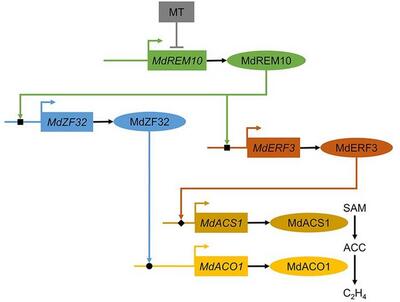
The researchers first observed that melatonin levels decrease while ethylene levels increase during natural apple ripening, suggesting opposing regulatory roles. Exogenous melatonin treatment reduced ethylene production and delayed visible ripening. Transcriptomic analyses identified MdREM10, a B3-domain transcription factor, as strongly suppressed in melatonin-treated apples.
Functional assays confirmed MdREM10 as a positive regulator of ethylene biosynthesis. Overexpressing MdREM10 in apple fruit accelerated ripening and increased ethylene output, and melatonin could no longer effectively suppress this response. Further investigation revealed a two-branch regulatory cascade:
- MdREM10 binds directly to the MdERF3 promoter, activating MdERF3, which in turn promotes transcription of MdACS1.
- MdREM10 also binds to and activates MdZF32, which enhances MdACO1 transcription.
Together, MdACS1 and MdACO1 catalyse the key steps of ethylene biosynthesis. Melatonin delays ripening by reducing MdREM10 transcription, thereby decreasing activation of both downstream pathways. This reveals that melatonin regulates ripening primarily at the transcriptional control level, rather than through direct inhibition of enzymatic ethylene synthesis.
“Our findings identify MdREM10 as the key molecular hub linking melatonin signalling to ethylene biosynthesis,” the research team stated. “By uncovering how melatonin acts upstream to regulate transcription factors that govern hormone production, we provide a mechanistic explanation for melatonin's ability to delay ripening. This discovery not only advances fundamental understanding of fruit physiology but also highlights new opportunities to control postharvest quality through natural regulatory pathways.”
The findings have been published in Horticulture Research.
Cargill invests US$130m to expand poultry operations in Asia
As demand for protein and cooked poultry products continues to increase, Cargill is expanding the...
The Wagyu industry to gather in Adelaide next year
Organised by the Australian Wagyu Association, WagyuEdge'27 will explore how the industry can...
Solving the static charge dilemma for less clumpy shakes
A scientific discovery showing control of static charge left on surfaces could one day help to...