Reading Between the Lines: A Smarter Way to Verify Allergen Safety
Allergen management remains a priority consideration for food manufacturers in Australia and New Zealand. Recent studies in our region have found a relatively high prevalence of food allergies, especially amongst children, and for many years, we have observed a persistently large number of product recalls attributed to undeclared allergens. Consequently, there is a heightened awareness of food allergy risks in the manufacturing industry, amongst both regulators and retailers, and more broadly, within the general community.
Beyond maintaining an effective food safety management system, the Food Standards Code requires allergens to be declared clearly and correctly whenever present.
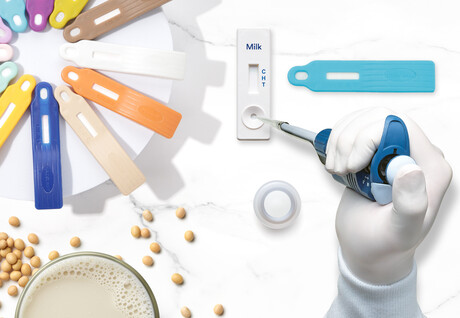
In this environment, rapid allergen verification tools such as lateral flow device (LFD) tests have become central to day-to-day risk management. And there is one feature, available on some products within that category, deserving of particular attention: the hook line, also known as an overload line.
Designed for rapid, on-site use, LFDs enable production teams to swab equipment, test rinse waters or screen finished products and receive results within minutes. They are not a replacement for accredited laboratory analysis, but they are a powerful verification tool embedded within an allergen management plan. They support pre-operational release decisions, validate sanitation effectiveness after allergen changeovers and provide confidence that cross-contact risks are being controlled before the product is dispatched.
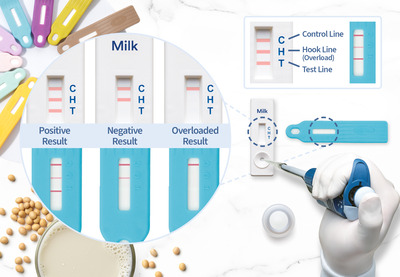
However, as with any immunoassay-based technology, interpretation matters. One of the lesser-known scientific challenges associated with lateral flow testing is the “hook effect” or prozone effect. In simple terms, when allergen concentrations in a sample are extremely high, they can saturate the antibodies in the test system in a way that interferes with the formation of the visible test line. Paradoxically, a heavily contaminated sample may produce a faint line or, in some cases, appear negative. In a fast-paced production setting, it is a risk that is easily overlooked.
This is why the inclusion of a hook or overload line in lateral flow allergen tests is a practical safeguard. Its presence clearly signals to the operator that the sample may be outside the optimal detection range and should be diluted and retested. Rather than leaving staff to question whether a weak or absent test line reflects a clean surface or an over-concentrated sample, the device itself provides an additional layer of interpretation.
In practical terms, the hook line significantly reduces the likelihood of a scenario where a surface that has not been adequately cleaned is mistakenly signed off as allergen-free. That protection is particularly valuable in facilities that handle high-risk allergens such as peanut, tree nuts, milk, egg or gluten across shared lines.
Operationally, the benefits are equally compelling. Australian and New Zealand manufacturers often operate high-mix, short-run production schedules. Changeovers must be efficient, but they cannot compromise safety. Rapid LFD testing allows sanitation teams to verify cleaning before production resumes, limiting downtime while maintaining compliance. When a hook line is present, the confidence in that rapid decision-making increases. Staff can distinguish between a true negative, a standard positive and an overload condition that requires further action. This clarity reduces rework, minimises unnecessary product holds and helps maintain throughput without sacrificing due diligence.
Robust environmental and product verification is essential for manufacturers making precautionary allergen labelling decisions or seeking to reduce unnecessary “may contain” statements. Lateral flow devices, used as part of a documented allergen risk assessment and validation program, provide the real-world data needed to justify those decisions. Features such as overload lines enhance the reliability of that data.
Of course, no rapid test is a standalone solution. Effective allergen management remains a multi-layered system that includes supplier assurance, ingredient segregation, validated cleaning procedures, staff training and periodic laboratory confirmation. But within that system, LFD allergen tests function as an accessible, frontline verification tool. They translate policy into practice on the factory floor. When thoughtfully designed to address known assay limitations, as with the inclusion of hook lines, they further reduce the margin for error.
Food manufacturers today are all too aware that allergen incidents can trigger recalls, regulatory scrutiny and lasting brand damage. More importantly, they can cause serious harm to consumers. Hook or overload lines may appear to be a minor addition to a test strip, yet they represent a significant enhancement in risk control. By helping to prevent false reassurance in the face of high allergen loads, they strengthen the overall allergen management framework and help deliver food that is not only compliant on paper, but demonstrably safe in practice.
Visit the Neogen website to learn more about our LFDs with hook lines and the full range of allergen testing solutions available.
How AI is changing the way food and beverage manufacturers prevent and manage recalls
Businesses that stand to benefit the most will be those with all their data in one place,...
Lone Star Bakery automates its dessert production line
When a new 'cheesecake in a cup' dessert was a success, Lone Star knew it was time to...
Predictive maintenance delivers savings for soft drink maker
An AI-based condition monitoring solution has been used to prevent downtime, and save bottles and...