What food-grade compressed air actually means
By Byron Raal, Founder and Editor, Compressed Air Solutions
Friday, 21 August, 2026
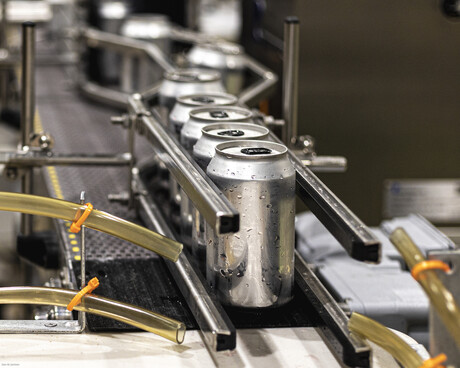
The compressed air in your plant is not just powering tools. It blows water off your cans before coding, conveys your flour and milk powder, and on an aseptic or drying line it meets the food directly. When air touches product like that it is effectively an ingredient, and a contaminated one can cost you a rejected batch, a failed audit, or a recall. Over-engineer it instead and you are paying for sterile-grade air to run a labeller. Either way it is a food-safety and a cost decision, yet most plants still file compressed air under maintenance: something you look at when a line drops pressure, not something on the food-safety register.
That is the gap. Compressed air that touches product is part of your food-safety system whether you have written it down or not. The job is matching the right air to the right zone, and being able to show your working.
FSANZ regulates the food, not the air
Start by clearing up the thing most people get wrong. FSANZ regulates food. It does not regulate compressed air, and it does not prescribe ISO air-quality classes. The Food Standards Code (Standards 1.4.1, 3.2.2 and 3.2.3) sets the contaminant and hygiene framework for the food itself; none of it names ISO 8573 or specifies a class for your air. If you read a supplier page that says a given ISO class is “FSANZ-required”, it is wrong, and you should not copy a number off it into your own spec.
What actually sets your target is your own Food Safety Program. That is the HACCP-based plan most sites run, often certified to ISO 22000 or SQF. It identifies where air contacts product, what the hazard is, and therefore what air quality each point needs. ISO 8573-1 is the engineering vocabulary you use to write that target down and verify it. An auditor does not hand you a class; they check whether the class you selected is adequate for the hazard you identified, and whether you can prove you hold it.
ISO 8573-1 is a measuring stick, not a rulebook
ISO 8573-1:2010 classifies compressed-air purity on three independent scales: solid particles, water and oil. You specify your air as a class on each scale, for each use point. That is all it does. It gives you a precise, testable language; it does not tell you that food production needs a particular number. The number comes from your risk assessment.
The contaminant that usually decides it is oil. If your source compressor is oil-lubricated, oil aerosol and vapour travel downstream unless you remove them, and oil on food is a defect you cannot wash off. Water is next, because moisture is what microbes need and a compressed-air line is a warm, dark home for them. Particles round out the three, carrying rust and scale shed from the pipework itself.
Match the air to the zone
Most food and beverage sites break into a handful of zones that do not want the same air. Three carry most of the decision, and the classes below are where a site usually lands after its own risk assessment, not numbers the standard hands you.
On a dry-powder line the enemy is moisture. Flour, sugar, starch and milk powder are hygroscopic, so wet air cakes them and feeds microbial growth. That calls for genuinely dry, oil-free air, which in ISO terms is Class 2 water, a pressure dew point at or below minus 40°C. Tool actuation on the packaging line is the opposite case. Cap tighteners, label applicators and case erectors never touch the food, so they do not need much: Class 4 water, around plus 3 degrees Celsius dew point, with oil tolerated at Class 2. Do not pay for more.
Direct product contact, such as an aseptic fill line, is the demanding end, because this is the air that ends up in or on the finished product. A conservative aseptic spec might run Class 1 water at or below minus 70°C dew point, Class 0 oil (the most stringent oil class), and Class 1 particulate, delivered through desiccant drying to that dew point, fine filtration sized to the oil and particle targets, and a sterile membrane filter, usually around 0.2 micrometres for bacterial retention. But that is a process-specific call, not a universal food default: plenty of food-grade work sits around the minus 40-degree mark, and the class you need is the one your risk assessment lands on. Class 0 is a purity level you specify rather than a number the standard fixes, and how you reach it is also a choice. An oil-free source compressor cuts the source risk but does not by itself prove Class 0; a properly maintained oil-lubricated machine on food-grade lubricant with point-of-use filtration is not automatically ruled out. Match the spec to the hazard and prove it at the point of use.
The point is that sizing every zone to the most demanding tier wastes capital, and sizing the demanding zones down to the tool tier creates a food-safety risk. Split the stream and spend where the hazard is.
Central treatment is not enough
Walk enough plants and the gap is almost always the same: a tidy filter stack in the compressor room, and a bare quick-connect at the line where the air actually meets the product. The instinct is to treat the air at the compressor and call it done, but air picks up contamination as it travels. Condensate forms as it cools in the lines, rust and scale shed from older pipe, and a single dead leg can undo clean air generated a hundred metres upstream. Food-grade air is a point-of-use problem. At each product-contact point you want the final filtration close to the use, sized for the class that point needs, with activated carbon where the oil target calls for it.
That is also where your control points live. Source-air intake quality, dryer performance measured by pressure dew point, filter loading tracked by differential pressure, distribution-line cleanliness checked by sampling, and point-of-use filtration all belong on the list. One caution: differential pressure tells you a filter is loading up, not that a sterile membrane is still intact. Membrane integrity needs its own validated test, such as a forward-flow, pressure-hold or bubble-point check. How often you sample and log is risk-based and set by your food-safety program, with scheme minimums to meet: SQF, for one, requires compressed-air analysis at least annually.
The short audit that makes the conversation easy
You do not need a consultant or a shutdown. The check has five steps.
- Map it. Walk the plant and mark every point where air contacts product or a food-contact surface. Most plants are surprised how many there are.
- Set the target. For each point, decide the class from the hazard and write it down in ISO 8573-1 terms. This is the document that turns an opinion into a specification.
- Check the treatment. Confirm the filtration and drying actually present at each point, and whether it matches the class you just set. This is where the gaps show, usually a central dryer standing in for a point-of-use filter that was never fitted.
- Test it. Verify the air at the point of use against your spec, using the ISO 8573 test methods. Measuring is what turns a plausible system into evidence.
- Record it. Keep the map, the specification, the filtration detail and the results together. That package is the compressed-air section of your food-safety plan, and it is what makes an audit a five-minute conversation instead of a finding.
It is food safety and it is money
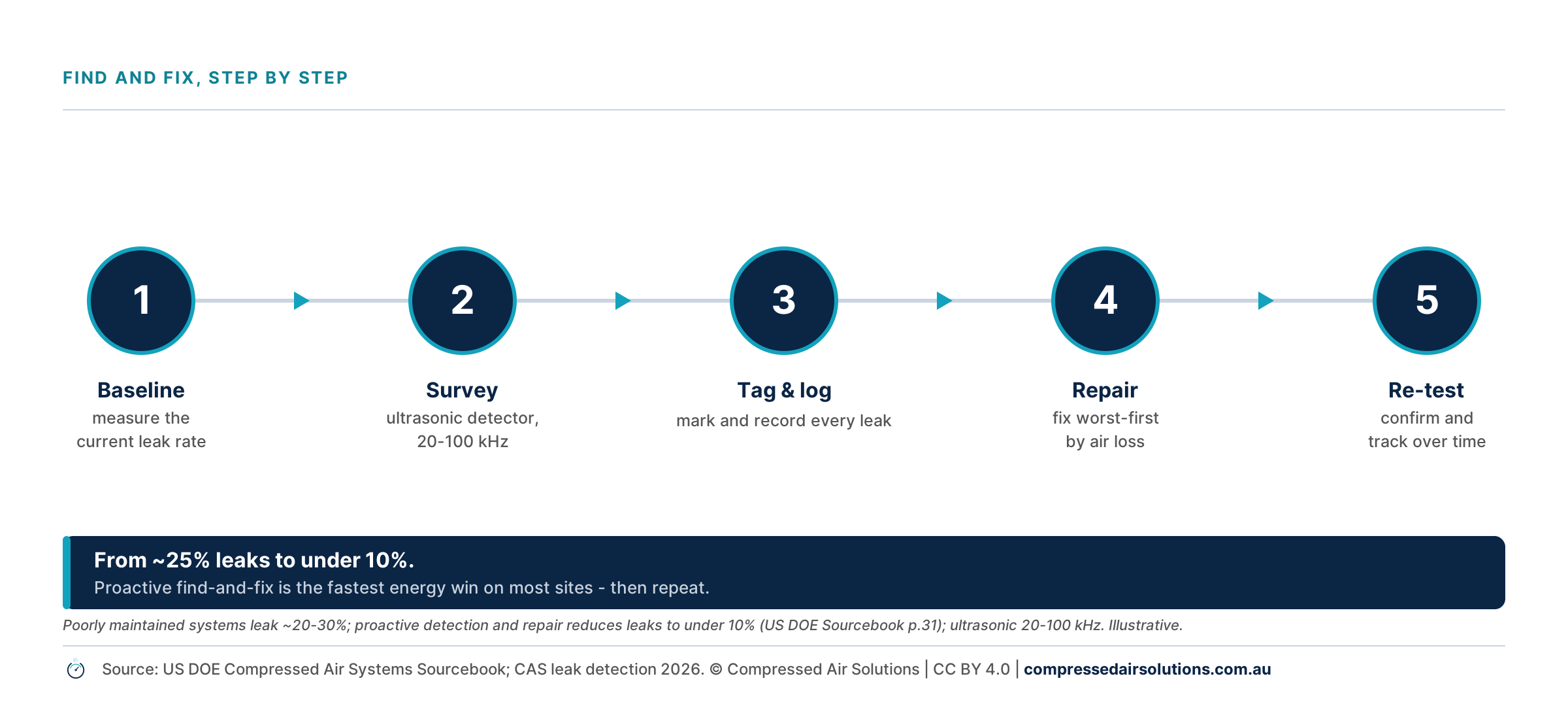
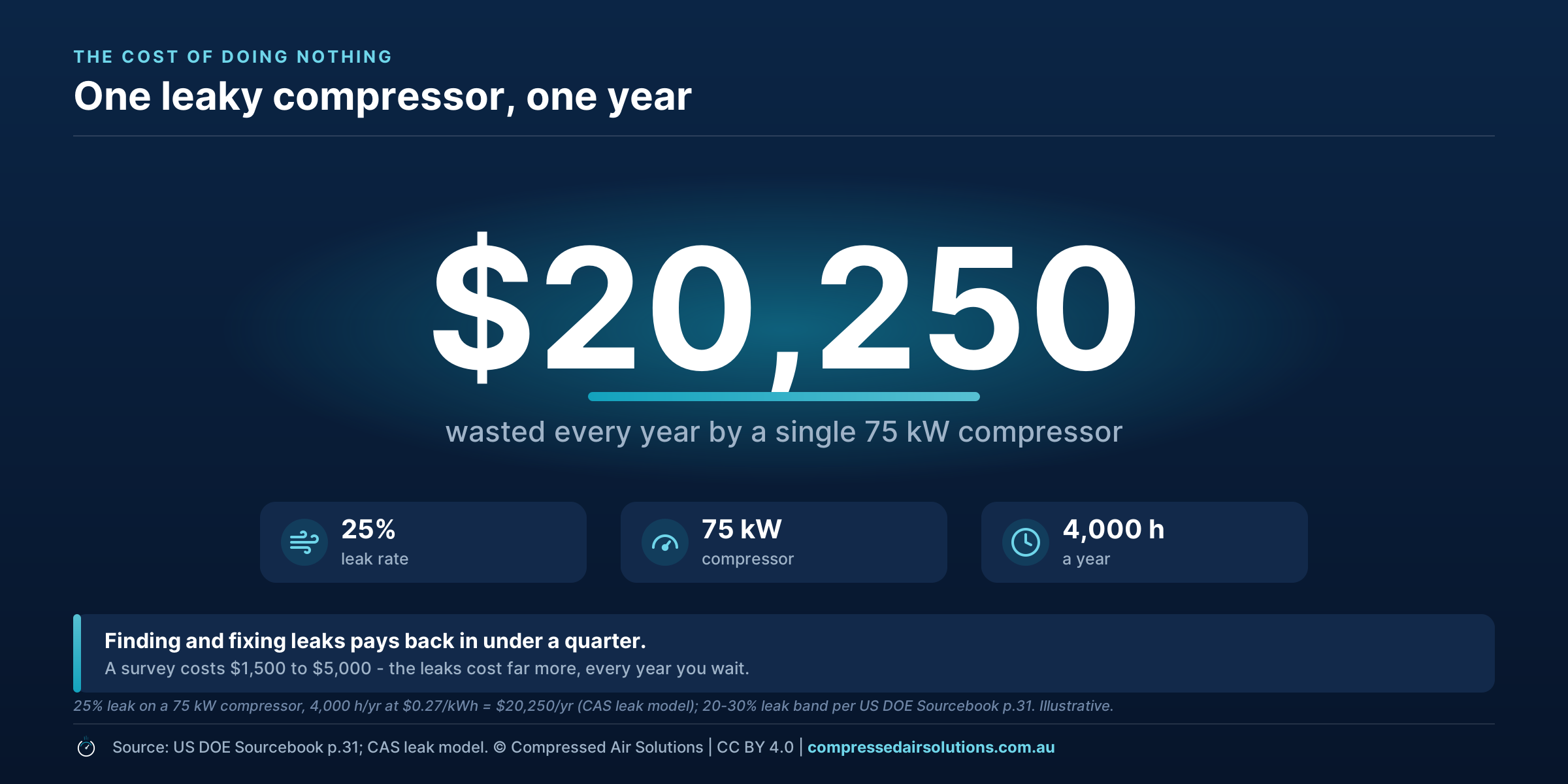
The same walk pays twice. A neglected system that fails a food-safety question is usually leaking a fifth to a third of the air it makes. On a continuously running site, that is real money: a single 3 mm leak at 7 bar draws roughly 2.85 kilowatts of compressor power continuously, which at current commercial tariffs runs to several thousand dollars a year on its own. An audit on a never-audited site typically finds 20–35% of compressed-air spend recoverable. You tag the leaks while you map the contact points, with the same eyes.
Compressed air in a food plant is not a maintenance service that occasionally needs a filter. It is a utility that touches your product, sits on your audit, and shows up on your power bill. Specify it like one, treat it at the point that matters, write it down, and it stops being the question you hope the auditor does not ask.
Predictive maintenance delivers savings for soft drink maker
An AI-based condition monitoring solution has been used to prevent downtime, and save bottles and...
Shaping the future using holistically designed beverage lines
Declining beer sales and changes in consumer habits are demanding a strategic realignment of the...
Upcycling soybean by-products into protein-boosted ingredient
A lab-scale study highlights the potential of a mushroom fermentation method to upcycle...