Beyond Ingredients: Building a Safer Food and Beverage Plant Through Better Air Quality Decisions
The future of food and beverage manufacturing depends on better decisions about everything that can influence product quality. Beyond ingredients and hygiene, manufacturers must consider the equipment, processes and utilities that support production. Compressed air is one such utility, and selecting the right technology can help strengthen process integrity and product protection.
When consumers purchase a carton of milk, a bottle of juice or a packaged meal, they expect safe ingredients, consistent quality and reliable packaging. Delivering that confidence requires more than a carefully developed recipe. It depends on the systems and processes supporting every stage of production.
Inside a food and beverage plant, products may be conveyed, mixed, filled, dried, sealed and packed. Throughout this journey, they encounter equipment, pipes, valves, contact surfaces and supporting utilities. Water, lubricants, gases and compressed air can all influence the manufacturing environment.
Food Safety Starts with Understanding the Entire Process
Ingredient quality, sanitation and finished-product testing remain fundamental to food safety. However, manufacturers must also understand potential contamination pathways throughout production.
Compressed air deserves particular attention because it supports applications ranging from conveying powdered ingredients and assisting with aeration to drying containers and operating packaging equipment.
Its relationship with the product varies. Air used to operate a pneumatic actuator may have no intended product contact, while air conveying flour can directly contact an ingredient. Air used to dry a bottle may influence a surface that subsequently touches the product.
The first step is to map these applications and identify where compressed air may have direct contact with food, indirect contact through product-contact surfaces, contact with primary packaging or a purely pneumatic function. This helps teams define appropriate air-quality requirements for each application.
Defining Air Quality at the Point of Use
Terms such as “clean air” are too broad for effective engineering decisions. Ambient air can contain particles, moisture, hydrocarbons and microorganisms, while compression, treatment, distribution and maintenance practices can influence the quality of air delivered to production.
ISO 8573-1 provides a recognised framework for classifying compressed-air purity across particles, water and oil. It enables manufacturers to establish measurable requirements according to the needs of individual applications.
Air quality depends on the complete system, not just the compressor. Dryers, filters, receivers, distribution pipework, condensate management and maintenance practices all influence the final result.
A reliable air-quality strategy combines appropriate compression technology with suitable treatment equipment, system design, regular maintenance and verification.
Oil-Lubricated or Oil-Free: Making the Right Choice
The choice between oil-lubricated and oil-free compression should be based on application requirements, contamination risk and lifecycle cost.
Oil-lubricated compressors use oil for cooling, sealing and lubrication within the compression process. Appropriate separation, filtration, drying, monitoring and maintenance can help these systems meet defined air-quality requirements for suitable applications.
Oil-free compressors eliminate oil from the compression chamber, removing one potential source of oil contamination during compression. This can be particularly valuable where oil contamination presents an unacceptable product or process risk.
Some facilities use oil-lubricated compressors with downstream treatment to achieve very low residual oil levels. Performance depends on system design, operating conditions, treatment equipment, maintenance and verification.
Manufacturers should consider energy consumption, pressure losses, consumable replacement, maintenance requirements and the consequences of air-quality failures alongside the initial equipment price. Food-grade lubricants may help manage risks associated with accidental contact where applicable, but they do not replace the need to prevent routine oil carryover.
The objective is to select a system that consistently delivers the required air quality while supporting operational efficiency and long-term cost effectiveness.
Class 0 Strengthens the Oil-Control Decision
For oil, Class 0 is the most stringent classification under ISO 8573-1. The agreed limit must be more stringent than Class 1. In applications where oil is a concern, Class 0 oil-free compressed air can provide an important level of control.
Class 0 addresses the oil component of air purity. Particles, moisture and microbiological conditions still require assessment, treatment and verification.
Manufacturers must define the required purity at the point of use and ensure that the complete compressed-air system can deliver it consistently.
Matching Technology to Production Requirements
For applications requiring Class 0 oil-free compressed air, ELGi offers two compressor technology platforms.
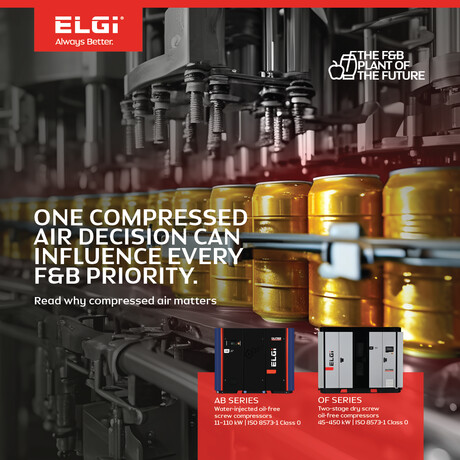
The AB Series water-injected oil-free screw compressors, available from 11 to 110 kW, use water-injected screw compression technology. The OF Series dry screw oil-free compressors, available from 45 to 450 kW, use two-stage dry screw compression and offer air-cooled and water-cooled configurations.
Selecting the right solution requires an assessment of air demand, pressure, duty cycle, cooling requirements, site conditions and future capacity. Treatment and distribution must also be considered as part of the complete system.
Better Decisions Build Lasting Confidence
Consumers may never see the compressors, dryers, filters or pipework behind the products they purchase. Yet these systems form part of the manufacturing environment that supports product quality.
Food safety becomes stronger when potential contamination pathways are identified, air-quality requirements are clearly specified and performance is regularly verified.
Compressed air is one of the many systems that deserve this attention. By combining application-specific risk assessment with appropriate technology and effective maintenance, food and beverage manufacturers can strengthen process control while balancing reliability, efficiency and lifecycle costs.
The future of food and beverage manufacturing will depend not only on better ingredients and processes, but also on better decisions about the systems that make safe, consistent production possible.
For more information, visit here.
What Makes an Enclosure Suitable for Hygienic Production?
When electrical infrastructure is installed within hygiene-critical production areas, stainless...
Beyond Ingredients: Building a Safer Food and Beverage Plant Through Better Air Quality Decisions
The future of food and beverage manufacturing depends on better decisions about everything that...
Robust cable solutions for food and beverage manufacturing
By choosing robust cabling from the outset, food manufacturers can help to protect the...