New method dehydrates fruit without heat
The water removal process of dried fruit often requires heat and energy. Now, researchers at Utah State University have developed a method to dry food at room temperature by adjusting air pressure conditions and using food-safe calcium chloride.
In a proof of concept, the system, published in ACS Food Science & Technology, successfully dried mango and apple slices to commercial levels.
Most tabletop and industrial-scale food dehydrators use circulated hot air to remove moisture, which is simple and effective but requires a lot of energy. Sun-drying foods uses mostly solar energy but is slow and darkens the final products.
In this recent study, the moisture-adsorbing salt calcium chloride, an ingredient used in cheese and molecular gastronomy applications, was incorporated into a room-temperature dehydration method and tested to see if it would impact the drying fruit’s colour.
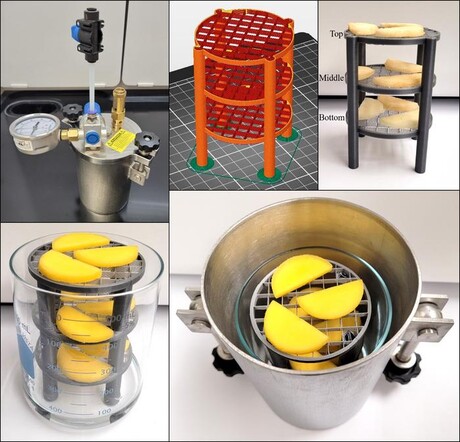
The researchers built a no-heat dehydrating chamber with three sets of screens above a container of calcium chloride solution. They placed mango and apple slices on the screens and then compared two room-temperature drying methods: one with the chamber at standard air pressure and the other under a slight vacuum.
After four days under standard air pressure, the calcium chloride solutions drew out and adsorbed less moisture from the fruits than those placed under vacuum.
The fruit slices at standard air pressure also dried inconsistently. Slices on the top screen contained 50–70% water (by weight) and those on the bottom had 20–30% water after the dehydration process.
In contrast, the vacuum-assisted method produced consistently dried mango and apple pieces made up of about 30% moisture, which is similar to the amount in commercially available dried fruit, and represented a removal of approximately 95% of the initial water mass.
Vacuum-dried mango pieces kept the raw fruit’s attractive bright yellow colour; however, the two dehydration methods darkened the apples by similar amounts. In addition, scanning electron microscopy images showed breakdown of starch granules in all the samples, but more of them broke down under standard pressure, suggesting that the vacuum-assisted method slows down deterioration mechanisms and retains freshness. And the water pulled out of the fruit could potentially be reused.
Researcher Luis Bastarrachea said that “the collected water in the calcium chloride solution can be removed by evaporation, and the reconcentrated calcium chloride solution can be reutilised in more dehydration cycles”. Ultimately, the recovered water could be used in industrial applications or further treated for human consumption.
How AI is changing the way food and beverage manufacturers prevent and manage recalls
Businesses that stand to benefit the most will be those with all their data in one place,...
Lone Star Bakery automates its dessert production line
When a new 'cheesecake in a cup' dessert was a success, Lone Star knew it was time to...
Predictive maintenance delivers savings for soft drink maker
An AI-based condition monitoring solution has been used to prevent downtime, and save bottles and...