Dual conveying systems automate chocolate cream production
Burton’s Biscuit Co, a leading UK producer of biscuits and snack products, is best known for its ‘Jammie Dodger’ sandwich made of two shortbread biscuits with jam in the centre. To build on the product’s success, the company decided to market a ‘Chocolate Dodger’ version, made of chocolate biscuits with chocolate cream in the centre.
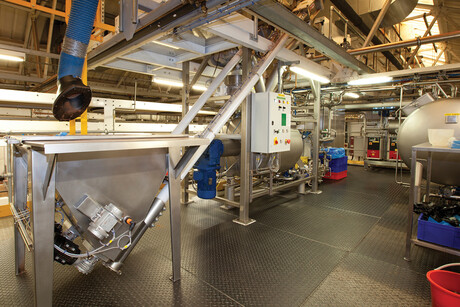
To produce the chocolate cream, the plant installed a batching/blending system consisting of flexible screw conveyors that transport cocoa powders to a horizontal paddle mixer, and a pneumatic conveying system that delivers finely milled sugar to the mixer. Flexicon supplied both conveying systems, each engineered to address the unique handling challenges of the materials.
Dual flexible screw conveyors move difficult-to-handle cocoa powder
Cocoa powder has a bulk density of approximately 560 kg/m3 and is non-free-flowing. The material has a tendency to pack, cake and form deposits on conveying equipment surfaces, particularly if exposed to moisture since it is also hygroscopic. In addition, it fluidises readily, and generates dust.
To move the troublesome material consistently while containing dust, the company specified two Flexicon flexible screw conveyors with screw geometry suited for the application.
The chocolate cream recipe calls for 15 kg of one type of cocoa powder, and 25 kg of another, both of which are manually dumped from 25 kg bags into a twin floor hopper that keeps each type separate. A vacuum extraction system connected to both hoppers withdraws any fugitive dust generated from dumping activities. The hoppers are also equipped with an electromagnetic vibration system that promotes flow of material into the inlets of flexible screw conveyors that transport cocoa to the mixer.
Each conveyor consists of a stainless steel flexible screw, housed in a 3 m-long, 90 mm OD plastic tube that is inclined at 70°. From the discharge spouts of both conveyors, material flows to a common wye fitting and then through a single downspout that discharges into the mixer.
The screw is engineered with special geometry to minimise radial forces and maximise longitudinal flow of the material to prevent packing of the compressible material. As the flexible screw rotates, it self-centres within the tube providing clearance between the screw and the tube wall to minimise grinding or heating/melting of the powder.
The conveyors are started and stopped by the PLC to move 15 kg of one cocoa powder, and then 25 kg of the other, to the mixer. Each conveyor moves material at the full feed rate of 1.85 m3/h, and then steps down to trickle feed rate before stopping, once the accurate target weight is gained by the mixer.
Hygroscopic sugar conveyed 200 m pneumatically without plugging
Unlike cocoa powder, the sugar powder needed for the process is free-flowing (when dry) and is sourced from a distant plant location, leading Burton’s to specify a Flexicon PNEUMATI-CON pneumatic conveying system.
The plant receives sugar in granulated form, which is milled to a fine powder, and then fed from a hopper through a rotary valve into a 200 m-long, 75 mm-diameter stainless steel pneumatic line.
Powered by a blower located upstream from the sugar intake point, the pneumatic conveyor has a capacity of 2110 kg/h. Since the fine powder will readily agglomerate and block the line in the presence of moisture, a key requirement is to keep the sugar warm and dry — achieved by means of a de-humidification system. This is especially critical because the pneumatic line contains four 90° elbows and four 30° elbows where plugging would otherwise occur.
A 915 mm-diameter filter receiver separates the sugar from the air stream, before it enters a 500 kg-capacity receiving hopper, located above the mixer. Just before entering the mixer, the sugar passes through a 915 mm-diameter vibratory screen with 1.0 mm openings, which retains oversize material.
Once palm oil and liquid chocolate are added to the batch, the PLC cycles the mixer, opens a discharge valve, and pumps the chocolate cream blend to the sandwich production line.
58% of food manufacturers report less productivity, research finds
Argon & Co research found that Australian food and beverage workers were still doing a lot of...
Humidification solution for Tasmanian Botanics
Australian medicinal cannabis producer Tasmanian Botanics required a solution to control humidity...
How AI is changing the way food and beverage manufacturers prevent and manage recalls
Businesses that stand to benefit the most will be those with all their data in one place,...