Integrated bulk handling system boosts gluten-free food production

Gluten-free, once considered a fad, has now moved mainstream with between 10 and 15% of households globally eating gluten-free foods. More growth is projected, with the global gluten-free market expected to reach between $11.5 billion and $18.6 billion by 2033.
One example comes from Bakery On Main, a US producer of gluten-free foods that needed to improve its bulk handling operation to support gluten-free baked goods production.
“We were operating at 100% of capacity. Our bulk handling equipment, which consisted largely of inclined conveyor belts, was inefficient and very labour-intensive,” said Michael Smulders, owner of Bakery On Main. “It was also an open system, so ingredients were exposed to the atmosphere.”
After investigating various ways to upgrade the existing equipment, all of which proved unsatisfactory, Smulders decided to build an entirely new facility with an integrated bulk handling system designed specifically for gluten-free baked goods. He commissioned an independent engineering firm to handle the overall design, which worked closely with Project Engineering Division of Flexicon Corporation to create a fully integrated system based on the company’s FLEXI-DISC Tubular Cable Conveyor (TCC) system.
Tubular Cable Conveyor principle of operation
Inside the TCC system, a series of low-friction polymer discs attached to a stainless steel cable gently slide bulk materials through smooth stainless steel tubing. Because of its gentle conveying action and dust-tight operation, a TCC system is ideally suited for transfer of fragile, contamination-sensitive food products.
Regardless of configuration, the low-friction polymer discs and cable are driven by a rotating wheel at one end of the circuit and maintained under tension by a wheel at the other end.
System integration permits fully automated granola production
The Flexicon kit for the granola handling system includes two FLEXI-DISC TCC circuits, a TIP-TITE Box Dump Station, a TWIN-CENTERPOST Bulk Bag Filler and two BULK-OUT Bulk Bag Dischargers.
The major granola ingredients are discharged from an extruder into the Bulk Bag Filler, which is equipped with an inflatable seal and a high-level sensor and indicator. Adjustable extension posts accommodate bulk bags as tall as 2300 mm when full — necessary because lower-density materials, such as those used to produce granola, occupy more space per pound/kilogram.
Palletised bags are then transported by forklift to a Dual Bulk Bag Discharger System which consists of two identical bulk bag dischargers, each with a cantilevered I-beam, electric hoist and trolley for loading and unloading bulk bags.
From each Bulk Bag Discharger, major granola ingredients flow onto a vibratory feeder and through an adjustable weir gate into a non-metered inlet adapter on a 150 mm diameter, 30.6 m long Tubular Cable Conveyor having one vertical and two horizontal sections. The weir gate is programmed to adjust the feed rate according to the bulk density of the material.
Both dischargers rest on load cells that measure weight loss and signal the vibratory feeders to stop when a pre-programmed weight has been transferred from the discharger to a mixer purchased separately by Bakery On Main.
Minor ingredients are manually deposited into a small hopper due to the need for higher accuracy, and introduced to the TCC through a metered inlet adapter. The combined ingredients are then discharged from the TCC through a full flow inline discharge adapter and fed into the mixer.
Once thoroughly blended, the ingredients are fed into an oven, which deposits baked material onto a moving conveyor belt. Baked granola then discharges into the surge hopper of a vibratory feeder that delivers the material into a non-metered inlet adapter of a 100 mm diameter, 52 m long TCC.
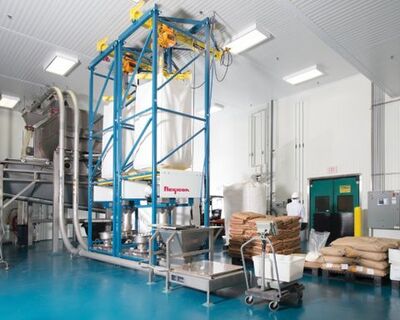
The TCC discharges finished product through inline tubular discharge valves into two packaging machines equipped with level sensors that signal a PLC to maintain surge hopper fill levels by starting and stopping the conveyor. Any excess granola is discharged through the system’s drive wheel discharge adapter into open boxes, which are transported by fork truck to a Box Dumper positioned at the intake end of the TCC. The boxes are hydraulically raised to create a dust-tight seal against a discharge hood, which is then rotated to mate with a gasketed non-metered inlet adapter of the conveyor, for re-transporting of the material to the packaging machines.
Close cooperation with engineering firm eliminated obstacles
Throughout the design, engineering and installation of this totally automated and integrated system, a team of engineers from the Flexicon Project Engineering Division worked closely with the independent engineering firm commissioned by Bakery On Main to handle the overall design. “The Flexicon team were detail oriented,” Smulders said. “They had all the engineering resources needed to tailor the system to our exact needs, including suspending everything except the fillers and dischargers from the ceiling in order to minimise our space requirements. They were responsive and very easy to work with.”
Lone Star Bakery automates its dessert production line
When a new 'cheesecake in a cup' dessert was a success, Lone Star knew it was time to...
Predictive maintenance delivers savings for soft drink maker
An AI-based condition monitoring solution has been used to prevent downtime, and save bottles and...
Shaping the future using holistically designed beverage lines
Declining beer sales and changes in consumer habits are demanding a strategic realignment of the...