'Smart' packaging film developed to confirm food freshness

Kyushu University researchers have developed a self-healing hydrogel that signals spoilage through colour change while extending food shelf life. By immobilising anthocyanins, a natural plant pigment, onto a metal-organic framework, the team stabilised the pigment against light and heat while preserving its pH sensitivity.
Flexible, largely biodegradable, and able to seal its own surface cuts, the soft, flexible film is embedded with a natural plant pigment that shifts colour as food spoils, giving consumers a visible signal without opening the package. The material can also repair its own cuts, which helps to keep bacteria out of the food while it progresses through the supply chain.
Freshness has a chemical signature. Meat, for example, starts mildly acidic. As bacteria multiply, they break down proteins and release alkaline compounds, so the meat’s pH climbs steadily before any visible spoilage appears.
Anthocyanins — the pigments behind the colour of purple sweet potatoes and red cabbage — track that shift directly. As pH rises, they turn from purple-red to yellow-green. This change is visible to the naked eye, and their natural origin also makes them safe for food contact. However, light and heat can easily disrupt their colour response, causing false readings and making them unreliable as a long-term indicator.
To address this challenge, the team sourced their anthocyanins from purple sweet potato, then ground and freeze-dried them into a powder. For stabilisation, they turned to UiO66-NH₂, a metal-organic framework (MOF) known for its thermal and chemical stability.
“MOFs have attracted enormous attention because of their unique porous structures and versatile functions, and I became curious whether they could be used for something closer to everyday life, like food preservation,” said Xirui Yan, corresponding author of the study and a JSPS researcher at Kyushu University’s Faculty of Agriculture. “At the HOPE Meetings with Nobel Laureates, I attended Professor Susumu Kitagawa's lecture on the sustainable use of functional porous materials. His perspective inspired me to think more broadly about how MOFs could create value in food systems.”
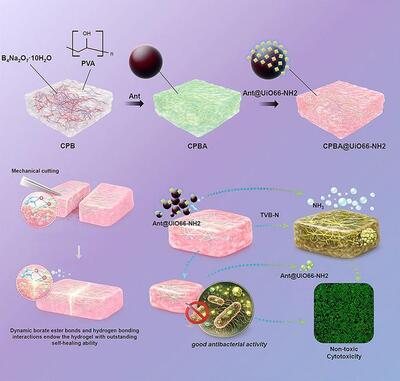
In their design, anthocyanin molecules adsorb onto the MOF’s surface through multiple chemical interactions, anchoring it in place. Fixed and less mobile, the molecules are shielded from the oxygen, light and heat that drive degradation while remaining sensitive to pH. In food tests using pork, the protected pigment was claimed to be consistently responsive: as the meat spoiled and alkaline gases accumulated, the material shifted continuously from purple-red to yellow-green, giving a readable signal at every stage.
The team then incorporated the anthocyanin-loaded MOF into a hydrogel, producing a soft, shapeable film that is largely plant-derived and biodegradable. Beyond freshness monitoring, the material also extended the shelf life of pork by about 12 hours compared to untreated samples.
“Another interesting thing about this material is that it doesn’t just protect food — it heals itself,” said Fumihiko Tanaka, Professor at Kyushu University’s Faculty of Agriculture. When cut and pressed back together, the damage becomes nearly invisible within minutes, and tensile strength recovers to 99% within two hours. “In conventional packaging, any crack is permanent and becomes an entry point for bacteria. This material bonds back together on its own. The wound heals, and so does its ability to protect what’s inside, which makes it more durable and reliable in practical use.”
The team is now exploring a companion smartphone app, providing manufacturers, logistics companies and shoppers with an objective way to assess food quality in real time.
“This doesn’t have to stop at food packaging,” Tanaka said. “Smart materials built from natural ingredients and nanotechnology may have uses we haven’t imagined yet. If anyone sees a place where this could work, we'd love to hear about it.”
In a study has been published in Chemical Engineering Journal.
Resealable pouches to preserve freshness of cucumbers
StePacPPC's 3-in-1 zipper pouch has been used as a snack pack for baby cucumbers.
Product profile: making multihead weighing easier for operators
Equipment that is easier to operate, easier to clean and simpler to maintain can make a...
Packaging refresh for Victorian craft spirits brand
Peacock Bros has worked with Organic Bay Distillery on a packaging redesign to help strengthen...