Banana peels used to extend shelf life of cherry tomatoes
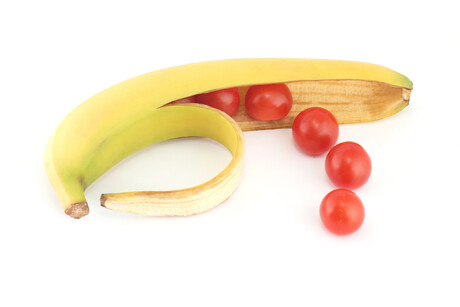
Fruits and vegetables keep ‘breathing’ even after they’re picked. Respiration consumes sugars and organic acids that contribute to flavour, while moisture loss and continued ripening soften the fruit. These changes shorten shelf life and contribute to food waste. Thin edible coatings can be applied to regulate gas and water transfer and preserve fresh produce. Now, food scientists are exploring whether by-products we often discard could supply ingredients for these coatings.
In a study published in Food Bioscience, a team led by Professor Fumihiko Tanaka and Associate Professor Fumina Tanaka of Kyushu University’s Faculty of Agriculture examined banana peels for this purpose. They added proteins, polysaccharides or lipids extracted from the peels to an edible coating and compared their effects on cherry tomatoes. The lipid-containing coating was most effective at slowing moisture loss and keeping the tomatoes firm.
“We wanted to turn one source of waste into a way to reduce another,” said Jiao Zeng, the paper’s first author and a PhD student at Kyushu University. “Banana peels account for about a third of the fruit’s weight, yet they are usually discarded despite containing valuable compounds. We explored whether these compounds could help cherry tomatoes stay fresh for longer.”
The researchers extracted proteins, polysaccharides and lipids from discarded banana peels and added each separately to a coating made from sodium alginate and cinnamaldehyde. Sodium alginate is a substance derived from brown seaweed that forms the coating’s film structure. Cinnamaldehyde, a compound found in cinnamon, contributes antimicrobial activity.
The researchers found that the three components affected the coating in different ways. Polysaccharides helped form a more closely connected network within the coating, while proteins contributed to interactions between its components. Lipids, meanwhile, formed water-repelling regions. Among the tested formulations, the lipid-enriched coating showed the most effective preservation performance.
“Lipids enhanced the hydrophobicity of the coating and significantly improved its moisture-barrier properties, thereby reducing water loss during storage,” explained Fumina Tanaka.
The team then tested the coatings on cherry tomatoes stored at 25°C. By day 15, uncoated tomatoes suffered over 30% weight loss and visible decay, whereas all coated variants mitigated deterioration. The lipid-based coating performed best, maintaining marketable quality for over 20 days. The researchers also observed lower respiration and reduced ethylene production, which acts as the primary chemical trigger for fruit ripening. Coated tomatoes also showed a slower loss of firmness and less juice leakage.
Sensory tests of appearance, texture, aroma and taste showed a similar pattern. The uncoated tomatoes fell below the study’s acceptable quality by day 15, while those treated with the lipid coating remained acceptable through day 20. They also maintained higher levels of soluble solids, including sugars that contribute to sweetness.
“Our study revealed how each component contributes to preservation,” Fumihiko Tanaka said. “We hope to develop this approach further to reduce food loss and support a circular bioeconomy, where agricultural by-products become valuable resources.”
Although the coatings have so far been tested only on cherry tomatoes under specific storage conditions, the findings suggest promise for preserving fresh produce after harvest. The researchers plan to test fruits and vegetables with different ripening and storage characteristics to determine how widely they could apply the approach.
Fresh-Lock zipper and slider closures
Fresh-Lock has a range of zipper and slider closure solutions for flexible packaging.
wenglor miniature fork and label sensors
The fork sensors from wenglor enable object detection in confined spaces, while the label sensors...
GEA PowerPak 5000 thermoforming packaging machine
GEA has introduced the PowerPak 5000 thermoformer for mid-range food packaging applications.