Engineering better 3D-printed foods through ink research
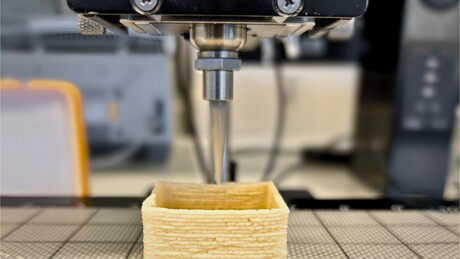
Food printing has potential for many more applications, such as creating meals for people with niche dietary needs with exact nutritional values or specific textures. However, the food-based inks and pastes used for printing seldom behave like typical printing materials, and it’s not always clear how they will behave when fed through the nozzle of a 3D printer. Predicting the response of these materials is an important first step to engineering better 3D-printed foods.
In Physics of Fluids, by AIP Publishing, researchers from the Eindhoven University of Technology and Wageningen University and Research in the Netherlands simulated the process of food inks being printed. Their work could help engineers build better food printers, design better food inks, and make this technology more widespread.
“Food inks have a complex behavior,” said author Yagmur Bugday. “They remain completely solid while resting but transition smoothly into a flowing fluid when pushed through a printer nozzle. It is both challenging to accurately measure this response and capture it with a model that transitions smoothly and continuously from a solid to a liquid.”
Key to simulating food inks is capturing this ‘extrudability’ — or how easily inks flow through the printer nozzle — which can be represented computationally. Previously, the research group developed a model that did just that, capturing the transition from solid to liquid and back again. In this study, they implemented this model to examine two types of food ink, one rich in protein and one composed mainly of fibre.
“We implemented the material model that captures the solid-to-liquid transition into an extrusion process model to predict the force required to push the ink through a syringe,” Bugday said. “We then ran the simulations and compared the predicted pressure difference against experiments that measured the extrusion force.”
The team found their model accurately predicted the behaviour of the protein-rich ink, but it overestimated the extrusion force for the fibre-based ink. The researchers suspect this is because water in the ink coats the walls of the nozzle, causing the ink to slide during the extrusion process in a way unaccounted for by their model.
The authors plan to further develop their model to include the complications from wall sliding, as well as account for how the material changes and breaks down over time, to provide a more comprehensive tool for groups looking to create better 3D-printed food.
“By modelling the extrusion process, this work guides engineers in developing nozzle design strategies, establishing processing limits for equipment, and adapting ink formulations to machinery constraints and customer specifications,” Bugday said.
Closing the sensory gap with no- and low-alcohol wine
Reducing alcohol in wine changes sensory characteristics, so researchers are exploring ways to...
pladis program plans to help with a snacking reshape
The second year of pladis's Accelerator Programme is now open for food-tech startups that can...
Scientists identify a novel peptide derived from red alga
Seaweed is commonly used as an ingredient in many food products, but researchers have now...