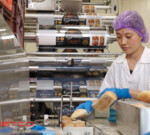
Foreign body inspection as a food safety measure in infant nutrition

Foreign body contamination remains a recurring issue in the food industry and is consistently identified as a leading cause of product recalls. Based on aggregated analyses from food safety authorities and industry bodies, physical contaminants are responsible for an estimated 10 to 15% of global food recalls. In infant nutrition, where products are consumed by highly vulnerable groups, the acceptable risk threshold is extremely low.
Powdered products such as infant formula and milk powder are particularly sensitive. Multiple processing and packaging steps, combined with high-throughput production, increase the likelihood of unintended material entering the product stream. For this reason, manufacturers increasingly rely on end-of-line inspection systems as part of their overall food safety strategy.
Infant nutrition, where regulatory oversight and consumer expectations regarding food safety are especially high, requires consistent control measures throughout production. In addition to ingredient sourcing and process controls, inspection of finished, packaged products forms part of the quality assurance approach. This includes verification that products are free from foreign bodies before distribution.
An organic infant nutrition and baby food producer, Bellamy’s Organic, certified for the Australian and international markets, distributes its products in several regions, including Asia. At its production site in Braeside, Victoria, X-ray inspection systems inspect 800 g milk powder cans. This technology is commonly used in the food sector because it enables detection of both metallic and certain non-metallic contaminants, including plastics, rubber and dense organic materials, even in sealed packaging. Some of the inspected products include additional plastic components, such as caps and enclosed scoops. These elements increase inspection complexity and require careful system configuration to ensure reliable detection without excessive false rejects.
At Bellamy’s Organic, the inspection process is designed to minimise the X-ray path through the product, a standard principle in X-ray inspection. The system in use, a SC-S 4000 by German product safety specialist Wipotec, is configured with a horizontal beam orientation, often referred to as a sideview arrangement. This set-up can be advantageous for cylindrical containers like milk powder cans, which typically have a flat or slightly curved base, enabling more uniform inspection conditions.
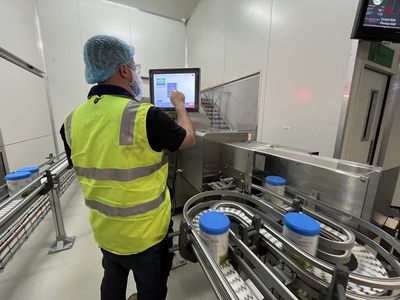
However, inspection systems must not only detect contaminants but also handle products in a controlled and repeatable manner. Chain conveyors are used to transport cans through the inspection area and to remove rejected products from the main line. Smooth rejection is particularly relevant for rigid containers, where deformation could create additional quality issues. And as in many food production facilities, Bellamy’s Organic operates under space constraints, so the system had to be adapted to the available layout, including flexible positioning of the human–machine interface. Such adaptations can improve operator access and visibility, which in turn supports correct system use and consistent application of inspection criteria.
From a food safety perspective, equipment durability and consistency are also relevant. Inspection systems are often expected to operate over many years, and stable performance reduces the risk of undetected failures. The SC-S 4000 system at Bellamy’s Organic was originally installed in 2017 and continues to operate as part of the production process.
The Bellamy’s Organic example illustrates how X-ray inspection systems are applied as part of a broader food safety framework. These systems do not replace upstream preventive measures, such as supplier qualification, maintenance programs or hygiene controls. Instead, they serve as a final verification step before products enter the supply chain. In infant nutrition, where recalls can lead to significant financial and reputational consequences, foreign body inspection supports the overarching goal of risk reduction. As regulatory expectations continue to rise globally, inspection technology is increasingly viewed as a standard component of responsible food production rather than a differentiating feature.
More information on the topic can be found at www.wipotec.com/au/x-ray-and-vision or by emailing info.au@wipotec.com.
How AI is changing the way food and beverage manufacturers prevent and manage recalls
Businesses that stand to benefit the most will be those with all their data in one place,...
Lone Star Bakery automates its dessert production line
When a new 'cheesecake in a cup' dessert was a success, Lone Star knew it was time to...
Predictive maintenance delivers savings for soft drink maker
An AI-based condition monitoring solution has been used to prevent downtime, and save bottles and...