Processing method to lower oil in French fries
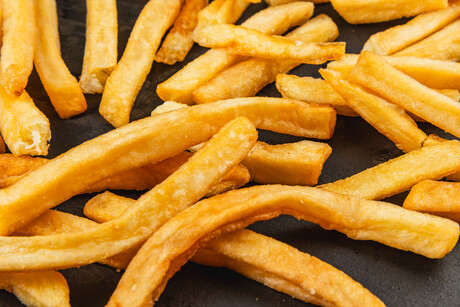
Researchers at the University of Illinois Urbana-Champaign have explored microwave frying of French fries, which could provide insights to help food manufacturers modify production methods for low-fat options. The proposed method combines conventional frying with microwave frying to provide crispiness and texture while reducing the cooking time and oil absorption.
“My research team studies frying with the aim of obtaining lower fat content without significant differences in taste and texture,” said principal investigator Pawan Singh Takhar, professor of food engineering in the Department of Food Science and Human Nutrition, part of the College of Agricultural, Consumer and Environmental Sciences at U of I.
In two new publications, Takhar and Yash Shah, a doctoral student in FSHN, discussed their findings from studies exploring what happens during microwave frying of French fries.
For the first study, published in the Journal of Food Science, they collaborated with colleagues at Washington State University, who developed a special microwave fryer that could operate both at 2.45 gigahertz (similar to a regular microwave oven) and 5.8 gigahertz.
The sample potatoes were rinsed and peeled, then cut into strips, blanched and salted. Batches of potato strips were then fried in soybean oil preheated to 180°C. The researchers measured temperature and pressure during and after frying, as well as volume, texture, moisture and oil content of the fried samples.
The challenge is to keep the oil from entering the food during and after the cooking process, Takhar said.
In the beginning of the frying process, the potatoes’ pores are filled with water, so there is nowhere for the oil to go. But as frying progresses, the water starts evaporating, so pore spaces are opened and oil is sucked into the food through negative pressure.
“Think about a straw in a drink. If you push air into the straw, it creates positive pressure and any liquid will be pushed out. But if you suck on the straw, the liquid moves upward. Now imagine food materials have lots of tiny straws. When there is positive pressure, the oil stays out. But if there is negative pressure, the oil starts moving in,” Takhar said.
Up to 90% of frying happens under negative pressure, so there is continuous suction potential. The goal is to keep the pressure positive longer and shorten the duration of negative pressure to prevent oil from entering the food.
“When we heat something in a conventional oven, the heat moves from outside to inside, but a microwave oven heats from the inside out, because the microwaves penetrate everywhere in the material. The microwaves oscillate water molecules, causing more vapour formation and thus shifting the pressure profile towards the positive side. The higher pressure in microwaves helps reduce oil penetration,” Takhar said.
In parallel with the lab experiments, the second paper, published in Current Research in Food Science, complements the results through mathematical modelling, which allows for much more detailed exploration of a variety of factors in the frying process.
The researchers explored the effects of temperature, pressure, volume, texture, moisture and oil at 2.45 GHz, 5.8 GHz and conventional frying. Overall, they found that microwave frying resulted in faster moisture loss, shorter cooking time and lower oil intake.
“However, if you just use microwave frying, you get soggy food. To obtain a crispy texture and taste, you need conventional heating. Therefore, we propose combining the two approaches in the same unit. Conventional heating maintains the crispiness, while microwave heating lowers the oil intake,” Takhar said.
Continuous fryers used for industrial-scale production of fried foods can be modified by incorporating microwave generators, which are inexpensive and readily available. Thus, this approach is likely to be economically feasible for industrial use, the researchers concluded.
Humidification solution for Tasmanian Botanics
Australian medicinal cannabis producer Tasmanian Botanics required a solution to control humidity...
How AI is changing the way food and beverage manufacturers prevent and manage recalls
Businesses that stand to benefit the most will be those with all their data in one place,...
Lone Star Bakery automates its dessert production line
When a new 'cheesecake in a cup' dessert was a success, Lone Star knew it was time to...