Robots that see around corners
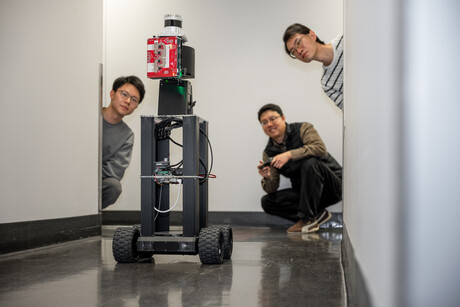
Engineers from University of Pennsylvania School of Engineering and Applied Science have developed a system that lets robots see around corners using radio waves processed by AI, a capability that could improve the safety and performance of driverless cars as well as robots operating in cluttered indoor settings like warehouses and factories.
The system, called HoloRadar, enables robots to reconstruct three-dimensional scenes outside their direct line of sight, such as pedestrians rounding a corner. Unlike previous approaches to non-line-of-sight (NLOS) perception that rely on visible light, HoloRadar works in darkness and under variable lighting conditions.
“Robots and autonomous vehicles need to see beyond what’s directly in front of them,” said Mingmin Zhao, Assistant Professor in Computer and Information Science (CIS) and senior author of a paper describing HoloRadar, presented at the 39th annual Conference on Neural Information Processing Systems (NeurIPS). “This capability is essential to help robots and autonomous vehicles make safer decisions in real time.”
At the heart of HoloRadar is a counterintuitive insight into radio waves. Compared to visible light, radio signals have much longer wavelengths, a property traditionally seen as a disadvantage for imaging because it limits resolution. Zhao’s team realised that, for peering around corners, those longer wavelengths are actually an advantage.
“Because radio waves are so much larger than the tiny surface variations in walls,” said Haowen Lai, a doctoral student in CIS and co-author of the new paper. “Those surfaces effectively become mirrors that reflect radio signals in predictable ways.”
In practical terms, this means that flat surfaces like walls, floors and ceilings can bounce radio signals around corners, carrying information about hidden spaces back to a robot. HoloRadar captures these reflections and reconstructs what lies beyond direct view.
“It’s similar to how human drivers sometimes rely on mirrors stationed at blind intersections,” said Lai. “Because HoloRadar uses radio waves, the environment itself becomes full of mirrors, without actually having to change the environment.”
While autonomous vehicles already use LiDAR, a sensing system that uses lasers to detect objects in the vehicles’ direct line of sight, HoloRadar adds an additional layer of perception by revealing what those sensors cannot see, giving machines more time to react to potential hazards.
A single radio pulse can bounce multiple times before returning to the sensor, creating a tangled set of reflections that are difficult to untangle using traditional signal-processing methods alone.
To solve this problem, the team developed a custom AI system that combines machine learning with physics-based modelling. In the first stage, the system enhances the resolution of raw radio signals and identifies multiple “returns” corresponding to different reflection paths. In the second stage, the system uses a physics-guided model to trace those reflections backward, undoing the mirror-like effects of the environment and reconstructing the actual 3D scene.
“In some sense, the challenge is similar to walking into a room full of mirrors,” said Zitong Lan, a doctoral student in Electrical and Systems Engineering (ESE) and co-author of the paper. “You see many copies of the same object reflected in different places, and the hard part is figuring out where things really are. Our system learns how to reverse that process in a physics-grounded way.”
By explicitly modelling how radio waves bounce off surfaces, the AI can distinguish between direct and indirect reflections and determine the correct physical locations of a variety of objects, including people.
“This is an important step toward giving robots a more complete understanding of their surroundings,” said Zhao. “Our long-term goal is to enable machines to operate safely and intelligently in the dynamic and complex environments humans navigate every day.”
This research was conducted in the Wireless, Audio, Vision and Electronics for Sensing (WAVES) Lab at the University of Pennsylvania School of Engineering and Applied Science, and was supported by the University of Pennsylvania.
Platform launches in Australia to help lift automation adoption
Robotics Australia Group has launched an initiative that is designed to take the guesswork out of...
Arnott's Group celebrates its suppliers at Sydney event
The Arnott's Group has celebrated the contributions of its supply partners across operations...
Top 6 impacts of robots, revealed in IFR position paper
The International Federation of Robotics' latest position paper reveals how robots can have a...