Fat recovery method for industrial ice-cream waste
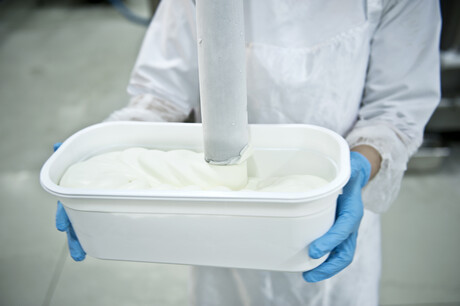
It has been estimated that nearly 5% of the raw materials used in ice cream production end up as waste, which represents millions of dollars in lost product per year. Now researchers at Penn State’s College of Agricultural Sciences have found a possible cost-effective method that could help to recover a large amount of fat from this waste. The recovered fat could then be used for other potential applications, such as animal feed, pharmaceuticals, cosmetics and other products.
Ice cream waste typically has a fat content three to five times that of cows’ milk, so the researchers found that it didn’t need complicated treatment for the fat recovery. All that was needed was a simple separation, such as centrifugation — a mechanical process that uses rapid spinning to separate mixtures of different sizes, shapes and densities — together with an alkaline treatment to aid the process.
“Here in the Department of Food Science at Penn State we have a close relationship with the food industry, so it was through our industry partners that we first heard about the magnitude of the ice cream waste problem,” said study senior author Yi Zhang, Frederik Sr. and Faith E. Rasmussen Career Development Professor in Food Science. “After offering the Ice Cream Short Course for over 100 years, we have ties to nearly every major ice cream company in the world, so we wanted to see whether we could help solve the problem.”
In the study, which has been published in Cleaner Engineering and Technology, the team worked with Perry’s Ice Cream in New York using around 40 kg of ice cream waste from four production batches at the ice cream manufacturing facility, with fat content ranging from 1.8 to 10.3%.
The first approach used to recover the milk fat was a process called proteolysis — which used enzymes such as pepsin, trypsin and bromelain to break down proteins that help stabilise the fat emulsion. The second approach used pH shifting, where they made the waste either strongly acidic (pH 2 or 4) or alkaline (pH 11) to destabilise the emulsion. After treatment, they centrifuged the material to separate the fat.
The team then measured the fat recovery and fat purity of both approaches, with surprising results.
“You might expect enzymes to be essential for breaking up the emulsion, but our study found that you don’t necessarily need them,” Zhang said. “The untreated control, when simply processed by centrifugation, recovered about 95% of the fat and actually improved fat purity compared with the original waste.”
Short enzyme treatments of one to two hours sometimes helped fat separation, but longer treatment, higher temperatures and extensive proteolysis did not increase the total amount of fat recovered and could actually decrease fat purity. The pH experiments found that pH 11 — strongly alkaline conditions — separated fat better than acidic conditions.
To analyse the economic implications of their findings, study co-author Rui Shi, assistant professor in Penn State’s Robert V. Waltemeyer Department of Chemical Engineering, and her team built a techno-economic model to evaluate how the fat recovery approaches could be incorporated into the industrial processes. It was estimated that the minimum selling price per kilogram of recovered fat would be about 40 cents.
The economics depended heavily on how much fat was present in the incoming ice cream waste. Higher-fat waste makes the process more profitable, because roughly the same amount of waste is being processed to obtain more valuable product. The research findings indicated that larger-scale processing operations could improve profitability.
Zhang and her collaborators will now continue to explore value-added products from recovered fat; recycling and reuse pathways for the other recoverable by-products in ice cream waste, such as proteins and sugars; and potential applications for using ice cream waste as a whole.
Blue-light approach to reducing Campylobacter in poultry
The novel technique developed in the UK to reduce surface contamination on poultry products is...
Krones rebrands its processing technology unit
Krones Group has announced the streamlining of its process technology business under a single...
Refining research helps optimise flavours of edible oils
A research team has identified the odour-active compounds responsible for the soapy and metallic...