Discovery improves flavour of Chinese spirits
Scientists in China have created a new material that makes Chinese spirits taste better — while also helping the environment. The breakthrough could give new life to distiller’s grains, the massive amount of by-product left behind in liquor production.
The team’s study, published in Biochar, describes how researchers transformed distiller’s grains into a composite material made of activated carbon and silica, known as AC-SiO2. Using a series of heating, chemical and steam treatments, they created a material with millions of tiny pores and special surface groups that are especially good at trapping unwanted compounds.
One of the key targets is benzaldehyde, a naturally occurring substance formed during fermentation. In small amounts, benzaldehyde can add to the aroma of spirits, but too much of it causes off-flavours and potential health concerns.
The new AC-SiO2 material was able to remove nearly 86% of benzaldehyde from Chinese spirits, greatly improving flavour quality. Importantly, the material kept working even after several rounds of reuse.
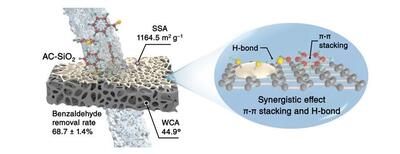
The scientists found that the activated carbon layers in the material ‘catch’ the benzaldehyde molecules through stacking interactions with their ring structures, while the silica side of the material forms hydrogen bonds with the aldehyde group. This one-two punch makes AC-SiO2 more effective than traditional adsorbents, which often struggle in alcohol-rich solutions.
“This work not only provides a green solution for the liquor industry but also shows how agricultural waste can be upgraded into something valuable,” said corresponding author Zhicheng Jiang of Sichuan University.
The research highlights a win-win approach: improving the flavour and quality of Chinese spirits while reducing pollution from waste disposal. Distiller’s grains, which are normally difficult to manage and can pollute soil and water, can now be recycled into a product that benefits both producers and consumers.
The findings may also inspire similar strategies in other food and beverage industries that are looking for ways to cut waste while boosting product quality.
Cargill invests US$130m to expand poultry operations in Asia
As demand for protein and cooked poultry products continues to increase, Cargill is expanding the...
The Wagyu industry to gather in Adelaide next year
Organised by the Australian Wagyu Association, WagyuEdge'27 will explore how the industry can...
Solving the static charge dilemma for less clumpy shakes
A scientific discovery showing control of static charge left on surfaces could one day help to...