AI-based hyperspectral camera to enable more food applications
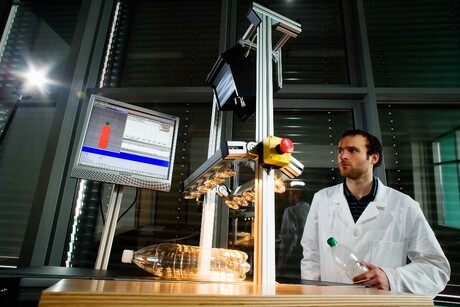
The OASYS project focuses on optoelectronic sensors for application-oriented systems. In the subproject A1, a team of scientists and industry experts is developing an ultra-compact, energy-efficient hyperspectral camera that uses artificial intelligence to perform complex material and quality analyses in real time. The integrated spectrometer records spectral characteristics, revealing chemical properties that are invisible to the human eye. This enables defects in food or the composition of textiles or plastics to be identified quickly and accurately.
The novel hyperspectral camera offers wide-ranging applications in industrial and agricultural processes. Its innovative approach combines conventional 2D imaging with artificial intelligence and spectral analysis. A standard 2D camera first captures a high-resolution image of the target object. Artificial intelligence then analyses the image in real time, automatically identifying regions of interest. The integrated spectrometer subsequently performs spectral analysis exclusively at these selected positions, determining the chemical composition. This intelligent approach enhances the efficiency of hyperspectral measurements. Rather than capturing spectral data across the entire image — a computationally intensive process — the system analyses only the relevant measurement points. This targeted method reduces data volumes, energy consumption and processing time.
The information obtained in this way supports, for example, the reliable sorting of textiles and plastics. It also increases the reliability of identifying counterfeit products. Additionally, it improves quality control in food processing by detecting pressure marks and defects, and enables an accurate assessment of plant condition and nutrient requirements in agriculture. Automated evaluation enables faster and more reliable decision-making. At the same time, processes become more sustainable, and economic resources are used more efficiently.
“With the compact hyperspectral camera from OASYS A1, we are developing technology that can be used directly in production lines, sorting facilities, or in the field for analytical processes,” explains Heinrich Engelke, project manager at the Fraunhofer Institute for Photonic Microsystems IPMS. “The combination of miniaturisation, energy efficiency and artificial intelligence opens up completely new applications, while also making an important contribution to resource conservation and process reliability.”
The components developed in the project will form the basis for future sensor systems that could improve industry, recycling, agriculture and the food sector.
Air Liquide to build industrial and medical gas plant in NSW
The plant is being built to enhance the local industrial and medical gas supply across Australia...
Fat recovery method for industrial ice-cream waste
Penn State researchers have developed a simple method that could help with the recovery and reuse...
Blue-light approach to reducing Campylobacter in poultry
The novel technique developed in the UK to reduce surface contamination on poultry products is...