A marbled swirl for plant-based meat
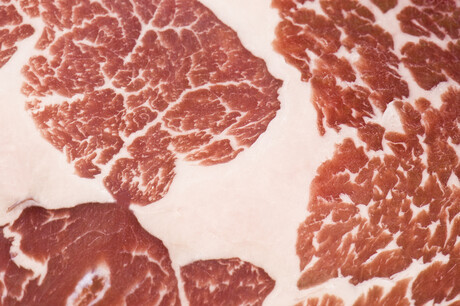
One of the challenges of creating realistic-looking and tasty plant-based meat is mimicking the marbled effect of animal fat. Now a University of Massachusetts Amherst (UMass Amherst) food scientist has a plan to tackle this quandary by developing new technology supported by a $250,000 grant from the Good Food Institute.
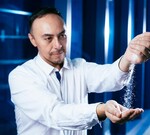
The technology proposed by Lutz Grossmann, an assistant professor at UMass Amherst, has the potential to make plant-based meat products more appealing to a wider audience.
In 2020, a team of UMass Amherst food scientists, led by Distinguished Professor David Julian McClements, received a grant from the institute to develop a new approach for creating tasty, plant-based, protein-rich food that’s similar in texture to whole chicken, pork or beef.
Grossmann, whose research focuses on designing holistic approaches to increase the consumption of plant- and microbial protein-rich foods, aims to incorporate lipids into high-moisture extrusion processes, a technique used to replicate the juiciness, appearance and texture of whole-muscle animal meat.
“While high-moisture extrusion has become a primary method for creating meat-like textures from plant proteins, it currently lacks the ability to generate lipid marbling, a key characteristic for replicating the appearance, flavour and texture of traditional meat products,” Grossmann said. “The challenges of incorporating lipids into high-moisture extrusion processes are mainly related to the lubricating effect of plant lipids that disrupt the protein melt within the extruder barrel.”
In addition, injecting lipids during the cooling part of the process — when the meat-like structure is finalised — results in uneven distribution, leading to suboptimal texture, he added.
To overcome these challenges and bridge the gap between plant proteins and lipids, Grossmann is developing and will implement a novel extrusion segment that will facilitate the creation of the marbled appearance and texture of plant-based whole-cut meat products.
“The set-up basically works like a piping bag that allows for making a two-coloured swirl,” Grossmann said.
Industries transitioning away from gas, A2EP report released
More than 230 Australian industrial sites and commercial buildings will have switched from gas to...
Fat recovery method for industrial ice-cream waste
Penn State researchers have developed a simple method that could help with the recovery and reuse...
Air Liquide to build industrial and medical gas plant in NSW
The plant is being built to enhance the local industrial and medical gas supply across Australia...