Next wave in coffee brewing has large-scale potential
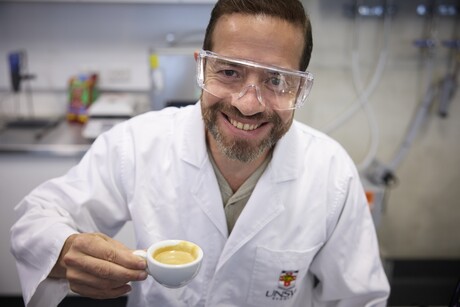
UNSW Sydney researchers have developed a new coffee brewing process that uses soundwaves and room-temperature water to create an espresso-strength coffee with the same rich flavour, body and caffeine kick as a traditional brew. The researchers believe the process could have potential interest for food manufacturers of coffee-based ready-to-drink products at industrial scale, both in terms of energy use and brewing time.
Dr Francisco Trujillo and his team from UNSW’s School of Chemical Engineering developed the system using ultrasound, high-frequency soundwaves that are far above what a human can hear, to help extract the desired flavour, aroma and concentration from coffee grounds. Their research, published in the Journal of Food Engineering, included blind taste-testing experiments which showed that their ultrasonic room-temperature version of espresso was indistinguishable from coffee shots brewed in the traditional way.
“We call it an ultrasonic espresso. It’s a different process, but you get the same richness and concentration of a normal espresso in under three minutes,” Trujillo said.
“Traditionally, espresso is [made] by forcing hot water through coffee under pressure. But with ultrasound we can use room-temperature water instead, reducing energy consumption by up to 75%.”
Espresso strength using a cold brew process
Trujillo had previously developed the patented ultrasound system to create cold-brew coffee, which usually takes 12 to 24 hours to produce, in as little as three minutes.
However, cold-brew coffee has a distinctively different flavour from espresso — often described as being much more diluted, smooth and mellow — while also containing around one-fifth the caffeine concentration.
The UNSW team continued their work to adjust the ultrasound system to create an espresso-strength shot without the need for hot water.
The process transformed a traditional filter basket into an ultrasonic reactor to brew the grounded coffee beans. The basket generates high-frequency soundwaves that help extract flavour, aroma and body from the coffee grounds.
At the heart of the system is a transducer — a small metal device that generates ultrasound while pressing against the side of the coffee basket holding the ground coffee. The ultrasound causes the basket to vibrate rapidly, transmitting vibrations through both the coffee grounds and the water.
The ultrasound creates a phenomenon called acoustic cavitation, which is a rapid formation and collapse of microscopic bubbles in the liquid. When these tiny bubbles collapse near the coffee particles, they act like microscopic scrubbing brushes or jets of liquid, pitting and fracturing the coffee grounds and accelerating the brewing process.
This helps break open the surface of the coffee grounds and allows flavour compounds, oils, and caffeine to move into the water much faster than they normally would at such low temperatures.
The result is a concentrated, flavourful shot of coffee comparable to espresso made with traditional machines, but produced using room-temperature water and much less energy.
“We have been working on a range of parameters to discover how to make the perfect ultrasonic espresso,” Trujillo said.
“The most important was the brew ratio — that is how much water is used per gram of coffee — because this helps ensure the final drink is concentrated and not too diluted.
“Another important factor is how finely the coffee beans are ground. We found that by grinding finer we could extract the flavour more rapidly.
“We also experimented with how long the soundwaves were applied, as this can affect both the concentration and flavour of the coffee. What we found is that between two-and-a-half and three minutes is a sweet spot for producing a balanced cup.”
Put to the taste test
Around 100 regular coffee drinkers took part in a taste test of four drinks: traditional espresso, ultrasound-brewed espresso, traditional filter coffee and ultrasound-brewed filter coffee.
For the espresso shots, there were no significant differences between the traditional and ultrasound versions across any of the taste measures. Most participants could not reliably tell them apart, and there was no clear preference for either method.
For filter coffee, however, the ultrasound-brewed version performed even better: participants significantly preferred it overall, particularly rating its bitterness as more pleasant.
“These findings showed that using ultrasound did not harm taste, and in some cases even improved it, despite brewing at room temperature and without the heat normally associated with coffee making,” Trujillo said.
The new system could be easily incorporated into coffee machines for home users, but the researchers believe the biggest opportunity is likely to be for large-scale commercial producers of coffee-based drinks.
“There are companies that make coffee products on an industrial scale and we are confident this ultrasound system can be scaled up to meet their needs, delivering real benefits in terms of reduced processing times and energy use,” Trujillo said.
“The 75% energy saving is particularly beneficial at that scale and we are also able to produce the coffee very quickly.
“Because the process produces a concentrated, espresso-strength coffee, it can be used directly to manufacture ready-to-drink products, or shipped as a concentrate and later diluted into a range of drinks, including cold brew and milk-based coffee drinks.”
In the video: Dr Francisco Trujillo shows how the coffee brewing process works
The importance of 'Hygienic by Design' for food inspection equipment
Keeping pace with hygienic design trends across factories and equipment is important for the...
A three-level strategy for preventing moisture 'drift' in food production
Controlling moisture in food production is critical because even relatively small changes can...
Digital Memosens technology for pH measurments
In food processing, pH measurement is rarely just about obtaining a number.