Improving efficiency of pharma packaging cleaning after filling
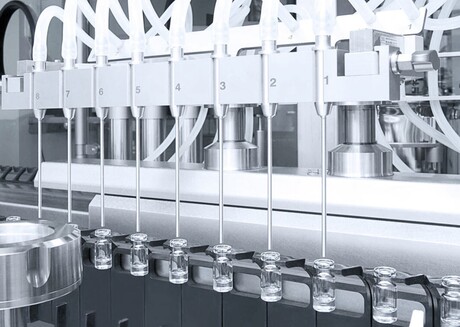
Cleaning the exterior of pharmaceutical containers such as bottles, vials and cartridges after filling prevents any adhering product residues from becoming a danger to humans and the environment. This process, which is traditionally liquid-based, consumes enormous amounts of energy and water and incurs high costs. In order to provide a more resource-friendly solution, a manufacturer of fill & finish machines participated in a joint project to investigate the suitability of the quattroClean snow jet technology. The results have confirmed that the sustainable cleaning process meets all the requirements of the pharmaceutical industry. A basic validation carried out in parallel simplifies the approval of the process in compliance with FDA and GMP regulations.
Reasoning behind the solution
“Due to the trend towards the use of increasingly potent active ingredients, there is a risk that the exterior of the containers could be contaminated with a potentially hazardous substance after filling. We are therefore seeing a growing demand for solutions to clean the outside of containers after the filling process. Not only do ever-stricter cleaning requirements have to be met, but the reliable removal of product residues must also be proved,” said Werner Iländer, Group Manager of Research, Technology and Pharma Services at Bausch+Ströbel.
Until now, external cleaning has generally been a liquid-based process involving spraying the containers with ultra-pure water and subsequently drying them with clean compressed air. This requires large quantities of water to be treated in an energy-intensive process and, depending on the product being filled, to be disposed of as hazardous waste. This not only results in high operating costs for users but is also a wasteful use of drinking water.
“For these reasons, we looked around for an alternative cleaning method that would make this process more cost-efficient and resource-friendly, as well as having a lower CO2 footprint. We have been working with the dry quattroClean snow jet cleaning technology from acp systems for some time and know that very high standards of cleanliness can be achieved, depending on the substance to be removed. However, we had no valid data on the material compatibility of the process,” Iländer said.
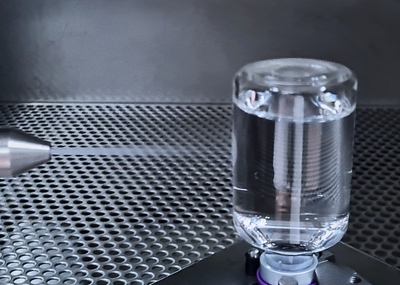
QuattroClean snow jet cleaning is a dry process for full-surface and localised applications that can be integrated into fully-automated production lines. The cleaning medium is liquid, recycled carbon dioxide, which is a by-product of industrial processes and used, among others, in the food industry. The liquid CO2 is guided through a wear-free two-substance ring nozzle and expands on exiting to form fine snow crystals. These are bundled by a separate jacket jet of compressed air and accelerated to supersonic speed. The focused jet of compressed air and ‘snow’ develops a combination of thermal, mechanical, solvent and sublimation effects on impacting the surface to be cleaned, which makes it effective. The removed contaminants are then extracted in the compact cleaning cell, thus preventing re-contamination of the product and contamination of the surroundings. Since the crystalline carbon dioxide sublimates during the process, the cleaned residue-free surfaces are dry, thereby eliminating the need for rinsing and drying steps.
Joint project to test the solution
Bausch+Ströbel, therefore, didn’t hesitate to participate in a joint project funded by Invest BW involving five industrial partners as well as Fraunhofer IPA and the NMI Natural and Medical Sciences Institute at the University of Tübingen. In the project, the material compatibility and cytotoxicity of the cleaning technology was investigated on various product surfaces typically found in the medical and pharmaceutical sectors.
“This project was primarily about proving that the mechanical forces of the snow crystals do not alter, impair or damage the surface in any way. It was also important to establish whether the thermal stress and/or the chemical properties of carbon dioxide affect the surfaces or biocompatibility of the containers, for example by releasing cytotoxic material components,” the group manager explained.
In addition to glass vials, test specimens made of stainless steel 1.4301 and 1.4305 with different surface finishes, as well as polyetheretherketone (PEEK), polyether (PE), polyoxymethylene (POM), nitinol and cobalt-chromium were included in the studies.
To evaluate the test series, Fraunhofer IPA examined the surfaces of the test specimens microscopically (light and/or scanning electron microscope) in their initial state and after cleaning. The dry jet cleaning process was carried out under worst-case conditions, ie, the middle section and edges of the test specimens were continuously irradiated with CO2 snow at a high pressure of 12 bar for 10 seconds. During the subsequent microscopic examination of the glass vials, no cracking was detected, and no propagation of existing cracks was observed.
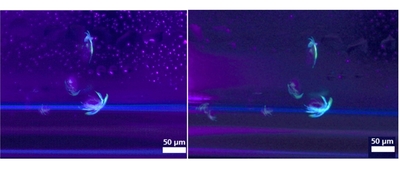
With the aid of a fluorescent penetrant, it was also possible to demonstrate that the snow crystals did not cause any additional stress in the glass. Likewise, the abrupt exposure to cold and the subsequent warming of the vials to ambient temperature did not result in the formation of any micro cracks. Furthermore, in vitro cytotoxicity tests in accordance with DIN EN ISO 10993-12: 2021-05 and DIN EN ISO 10993-12: 2021-08 confirmed that the CO2 snow does not impair cell vitality in any way. The VOC and SVOC analyses carried out according to ISO 16017-1 yielded Tenax values within or below the measurement limits.
GMP- and FDA-compliant process
The process therefore meets all the requirements of the pharmaceutical industry in this field; it is also compliant with GMP and FDA in terms of material compatibility, meaning that basic validation has already been achieved.
“In this project, we were able to generate the key data for our customers and develop a basic solution. The next step will be to implement this in a market-ready product that will significantly reduce operating costs and resource consumption in external cleaning for specific applications,” Iländer said.
58% of food manufacturers report less productivity, research finds
Argon & Co research found that Australian food and beverage workers were still doing a lot of...
Humidification solution for Tasmanian Botanics
Australian medicinal cannabis producer Tasmanian Botanics required a solution to control humidity...
How AI is changing the way food and beverage manufacturers prevent and manage recalls
Businesses that stand to benefit the most will be those with all their data in one place,...