Engineering a large-scale bulk handling system for a new production line
Adding a new production line requires more than just installing new processing equipment. Efficient expansion of production capacity is only possible with a well-engineered integrated bulk material handling system capable of transferring and processing ingredients at the volumes and rates needed to support continuous production.
One such example is of Smith’s Snackfoods, which needed to install a new process line to manufacture a lower-fat, oven-baked, crunchier variant of its traditional fried crisps.
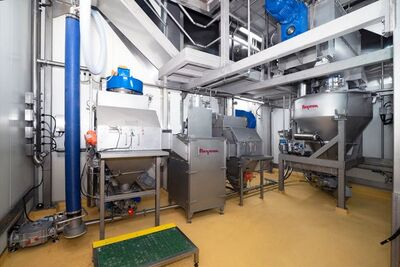
For the powder handling and blending portion of the new line, Smith’s worked with Flexicon Corporation Australia. Due to the size and scope of the new system, the supplier’s Project Engineering Division (PED) handled much of the design and specification work.
The new powder handling and blending system consisted of two upstream batch processes that feed a downstream continuous process.
In one batch process, major ingredients received in bulk bags were dispensed by weight from two bulk bag dischargers. Installed facing one another, the matching dischargers were each equipped with an electric hoist and trolley that travelled on an I-beam common to both frames, allowing bulk bags to be loaded from a single floor location.
The dischargers were each equipped with a clamp ring atop a telescoping tube that applied continual downward tension as the bag emptied and elongated, directing material through the bag spout. The sealed systems of both dischargers were vented to a dust collection system installed in an adjacent room, preventing contamination of the plant environment.
Bag activator plates raised and lowered opposite bottom edges of the bags on timed cycles, ultimately forming a steep ‘V’ shape that promoted total discharge. Both dischargers were also equipped with a flow control valve in which contoured stainless steel rods cinched the bag spout concentrically, allowing dust-free retying of partially empty bags.
When a batch was initiated, the rotary airlock of either discharger began metering material into a common pneumatic conveying line leading to a filter receiver suspended on load cells. Weight gain information was transmitted to the system controller that runs the airlock valve at high speed, then at dribble feed rate which, together with programmatic compensation for material in-flight, achieved precise batch weight accuracy.
Once major ingredients were batched in sequence from bulk bags, pre-weighed sacks of low-volume ingredients were positioned using a 25 kg vacuum sack lifter and dumped manually through a bag tip station with integral dust collector and a rotary airlock valve, feeding the same pneumatic conveying line. A chute through the sidewall of the bag dump hood led to a bag compactor with pneumatic ram that compressed up to 150 bags into a plastic-lined container for dust-free disposal.
The batch accumulated in the filter receiver was then gravity discharged into a paddle mixer. Blended batches were discharged into a buffer hopper that was sized to provide a continuous supply of material to the downstream process through a second pneumatic conveying system and filter receiver.
In a separate batch process, a bag tip station — also with integral dust collector, compactor chute and rotary airlock valve — was dedicated to manual additions of pre-weighed, pre-mixed inclusion ingredients. Positioned adjacent to the first bag tip station, it shared the same bag compactor, but metered material into a third pneumatic conveying system and filter receiver.
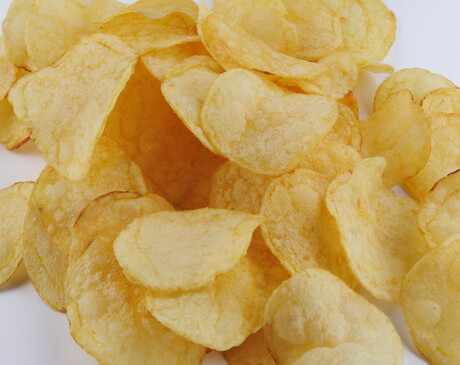
The second and third filter receivers were suspended on load cells that signal the system controller when to convey additional blended material from the buffer hopper, and from the second bag dump station, respectively. Rotary airlock valves provided material on an as-needed basis to a pair of loss-in-weight (LIW) gravimetric feeders, which allowed for rapid changing of screws to suit material flow characteristics, at throughputs from 4 to 400 kg/h. This overall arrangement allowed the LIW feeders to provide an uninterrupted supply of material to a new continuous mixer at precise ratios and rates, completing the powder handling and blending portion of the new Oven Baked potato chips line.
Drawing on its project engineering expertise, Flexicon Australia recommended system specifications, coordinated equipment from multiple manufacturers, and developed a controls and automation package for the bulk handling system that integrated with the facility’s overall process control system.
When production outgrows storage: the food and beverage warehouse challenge
Food and beverage manufacturers consistently prioritise production space over warehouse space,...
AI is quietly reshaping retail and consumers may not even realise it
Dematic says AI and automation are transforming how products are stocked, moved and delivered as...
Maize miller reaps the benefit of gravity metal detectors
At its remote Queensland site, Corson Grain Products installed a Fortress Technology gravity...