AI-powered robotic advances for chicken processing
Most automated poultry processing lines still rely on humans to lift slippery chickens onto a shackle conveyor. Now, a robotics system has been designed to imitate these human movements in an effort to fully automate the handling of chickens.
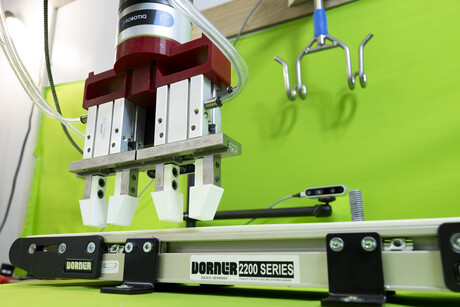
Using an advanced imitation learning algorithm and camera perceptions, researchers with the Arkansas Agricultural Experiment Station have developed ChicGrasp, a dual-jaw robotic gripper with pinchers that can grasp a chicken carcass by the legs, lift and hang it on a shackle conveyor to be moved on for further processing.
“Embodied AI is used to create intelligent, agent-like robotics to interact with a real-world environment,” said Dongyi Wang, leader of the project and an assistant professor in the departments of biological and agricultural engineering and food science.
“It’s a physical art that has just developed in the past couple of years, which you see in things like full self-driving cars,” he said. “We are trying to do similar things using that imitation learning idea, but in chicken processing.”
Results of the study behind the development of the robotic system have been published in Advanced Robotics Research. All computer-aided design files, code and datasets from the project were released as open source, providing what the team describes as a reproducible benchmark for agricultural robotics and robot learning.
How it works using diffusion policy
Traditional robotic methods, such as using suction cups or pre-programmed scripted motions, struggle in the unpredictable conditions of a poultry processing line. The birds are cold, slippery and not uniform in size or posture. Slight changes in leg position or carcass orientation can cause robotics to fail. To address this, Wang’s team designed a system that learns from human teachers rather than treating the gripper and control algorithm separately.
Amirreza Davar, a graduate student in the departments of mechanical engineering and biological and agricultural engineering, designed the gripper and modified the imitation learning to fit into the robotic system, Wang said.
“In imitation learning, the role of the human is to give a trajectory, give a ground truth to the robot, so we don’t need to start from scratch to learn,” Davar said. “It’s more efficient and more accurate. From the get-go, the robot knows what we need to do.”
The camera inputs, movements or trajectories, are stored in a directory that serves as the basis, or “low-dimensional” data, to control each joint in the robotic arm. The specific imitation learning algorithm used, diffusion policy, was introduced in 2023 by Cheng Chi of Columbia University and colleagues at the Toyota Research Institute and the Massachusetts Institute of Technology.
The system allows for an adaptive framework for continuously refining grasping strategies by formulating robot control as a “conditional denoising process”, Davar explained.
By comparison, other robotics learning methods failed entirely under the same conditions.
“That’s why we're getting inspired by this algorithm for the poultry industry,” Davar said. “Years ago, robots were programmed specifically to this specific coordinate at this specific time. But what if, like in the poultry industry, things are not predictable? You cannot engineer the robot to go exactly in this position. The chickens come in various sizes, and chicken legs are not always in the same position. So that’s why we wanted the robot to be able to adjust based on that specific scenario.”
Davar said the importance of the work behind ChicGrasp is not limited to the gripper itself.
“It’s the whole idea of imitation learning and generalisation combined with the gripper that makes it applicable and practical in the industry down the line,” he said.
Closing the speed gap
So far, ChicGrasp has shown a nearly 81% success rate, but the researchers emphasised that speed is still a challenge for industrial use.
A human can pick up a chicken carcass and hang it on the shackle conveyor in about three seconds. The full cycle for ChicGrasp is about 38 seconds.
Closing the speed gap will require both motion-level and algorithm-level changes, the study noted. This work would include the use of more aggressive velocity and acceleration limits for the robotic gripper arms and reducing idle time delays.
This work was supported by grants from the U.S. Department of Agriculture’s National Institute of Food and Agriculture in collaboration with the National Science Foundation through the National Robotics Initiative 3.0.
When production outgrows storage: the food and beverage warehouse challenge
Food and beverage manufacturers consistently prioritise production space over warehouse space,...
AI is quietly reshaping retail and consumers may not even realise it
Dematic says AI and automation are transforming how products are stocked, moved and delivered as...
Engineering a large-scale bulk handling system for a new production line
Adding a new production line for snack food requires more than just installing new processing...