Addressing bulk ingredient flow challenges in food & beverage handling
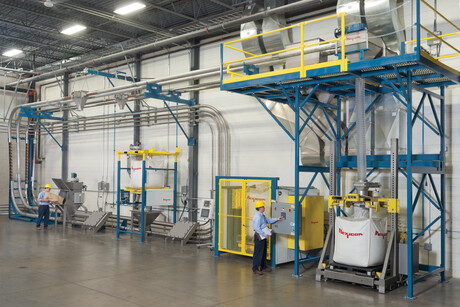
The successful discharge of ingredients from silos, railcars or bulk bags into food processing equipment usually requires more than vessel geometry, air pressure or gravity. Changes in material flow can be anticipated — but never predicted with complete accuracy. Setbacks such as unexpected flow obstructions, erratic discharge rates, or non-uniform feeding often require additional consideration.
Food ingredient characteristics such as shape, moisture content, bulk density, length of time materials have remained inert, and ambient conditions such as temperature and humidity, add additional layers of complexity. Additionally, the same ingredient sourced from various origins or at different times may display subtle (or substantial) differences in density, shape, or moisture content.
Here are four common causes behind ingredient stream flow issues:
- Bridging: ingredients such as fine powders, those with irregular particle shapes or with high moisture content, are prone to compaction — forming an obstruction, aka a ‘bridge’, that stalls flow.
- Ratholing: is commonly experienced in funnel-flow hoppers and with materials that compact or segregate during storage. Unlike bridging, the material continues to flow; however, slowly down a narrow channel in the vessel, leaving most of the material in the hopper.
- Agglomeration: is where individual particles adhere to one another and form large masses. Agglomeration is commonly caused by moisture absorption, temperature changes or the presence of fats, sugars or binders.
- Segregation: separation, or segregation, occurs when a previously blended food mixture begins to separate during storage or handling. Differences in particle size, density or shape cause fine or light particles to sift downward or heavy particles to migrate differently, resulting in inconsistent product composition.
Achieving reliable flow
Because no two bulk materials behave exactly the same, effective flow promotion begins with a clear understanding of an ingredient’s flow properties under actual operating conditions. Material testing, combined with real-world application experience, helps ensure that the selected solution addresses the root cause of flow problems.
Depending on the material(s) being handled, a food equipment manufacturer/designer will incorporate one or more of the following solutions:
Bulk bag activation:
Bulk Bags are highly valued for their ability to cost-effectively store and discharge large ingredient amounts. One disadvantage is the smaller diameter of the bag spout compared to its circumference.
If the material in the bag is completely solidified, a pre-conditioning procedure to loosen the material is necessary. Hydraulically actuated steel plates or rollers that press against the sides of the bag with the necessary force will loosen the material, allowing discharge through the bag spout.
Pneumatically actuated paddles and bag elongation devices are effective in ensuring consistent discharge of more free-flowing, yet problematic food materials. These paddles press and lift the bag upward while also creating downward tension on the bag spout — resulting in a ‘V’ shape at the bottom.
Effective discharge from steel vessels:
When gravity and vessel geometry are insufficient, steel vessel activation devices can initiate and sustain ingredient flow — either by reducing wall friction, breaking material adhesion or inducing controlled movement within the vessel.
Common steel vessel activation methods include:
- Mechanical or pneumatic external vibrators, which transmit energy through the vessel wall to reduce friction and collapse stable arches or ratholes
- Live-bottom or mechanically actuated discharge aids, such as agitators or de-lumpers, which physically move material towards the outlet
Preventing material segregation:
Ideally, blended bulk materials should not remain stationary for extended periods. Otherwise, gravity will take over, and heavier materials will sink to the bottom.
Flexible screw conveyors are well suited for conveying pre-blended or density-varied materials. These conveyors help prevent separation of blended materials by maintaining a consistent, controlled flow from inlet to discharge.
When production outgrows storage: the food and beverage warehouse challenge
Food and beverage manufacturers consistently prioritise production space over warehouse space,...
AI is quietly reshaping retail and consumers may not even realise it
Dematic says AI and automation are transforming how products are stocked, moved and delivered as...
Engineering a large-scale bulk handling system for a new production line
Adding a new production line for snack food requires more than just installing new processing...