What nutrients are in your milk?
When you pick up a bottle of milk at the supermarket, the nutrients it contains may depend on both what’s on the label and the time of year. A new study reports that omega-3 fatty acids are highest in milk labelled as organic grass-fed and lowest in conventionally produced milk. Other fatty acids varied by dairy production method and season.
“These findings contribute to a greater understanding of the role that production systems may play in determining the nutritional composition and potential nutritional value of milk,” said Emily Youngmark, MS, a PhD student at the University of Vermont. “The observed differences in fatty acid composition may represent one factor consumers consider when choosing milk products.”
Youngmark presented the findings at NUTRITION 2026 in July, convened by the American Society for Nutrition.
As there are a large array of dairy products marketed as organic, grass-fed or pasture-based and sold for a premium due to their nutritional advantages, the researchers sought to find out whether production systems actually influence milk composition.
Over the course of a year, the team collected over 300 samples of milk sold by retailers across Vermont and New York. Using information from dairy producers and product labels, they categorised each sample as conventional (63 samples), organic (111), organic grass-fed (91) or non-organic, pasture-based (40).
On average across all seasons, organic grass-fed milk contained significantly more omega-3 fatty acids than all other milks, providing 88 mg/serving compared with 25 mg/serving in conventionally produced milk. By contrast, omega-6 fatty acids were highest in conventionally produced milk, which contained 166 mg/serving versus 92 mg/serving in organic grass-fed milk.
The fatty acid composition of non-organic, pasture-based milk was generally comparable to organic milk, with some seasonal variation. In general, it appears that cows with more access to pasture and fresh forage produce milk with more beneficial fatty acids. Variation in nutritional composition throughout the year likely results from seasonal differences in forage quality.
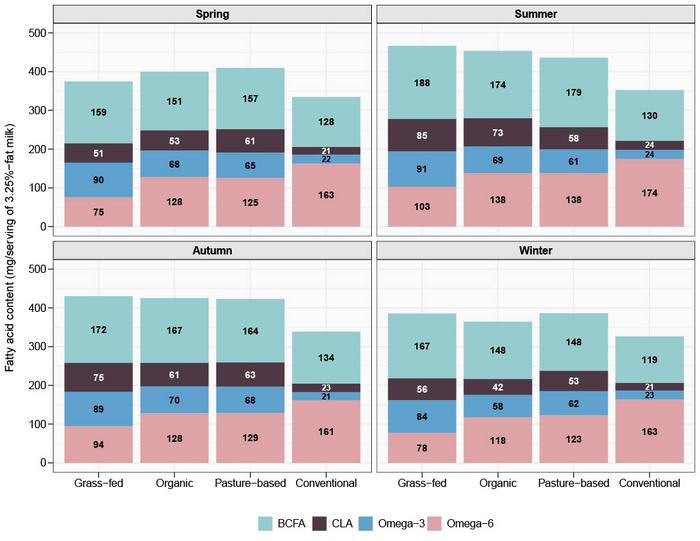
Stacked bar graph showing seasonal amounts of branched-chain fatty acids (BCFA), conjugated linoleic acids (CLA), omega-3 fatty acids, and omega-6 fatty acids per serving of 3.25%-fat milk (1 cup; 240 mL) across production systems: organic grass-fed, organic, non-organic pasture-based and conventional. Stacked bars represent the combined amount of these fatty acids, while individual segments indicate the contribution of each fatty acid group. Image credit: Emily Youngmark
Although the results revealed significant differences in fatty acid composition among milk samples, researchers noted that the health implications of these differences remain uncertain. Further studies would be needed to determine whether regularly consuming certain types of milk leads to measurable improvements in health outcomes.
“It is important to put these findings in perspective. While the differences we observed may be nutritionally relevant, they are unlikely to produce major health effects on their own. Rather, the fatty acid composition of organic grass-fed milk may contribute as one component of an overall healthy dietary pattern and lifestyle,” Youngmark said.
While milk naturally remains a good source of protein, calcium and several vitamins regardless of the cow’s diet, it is clear that feeding practices can influence certain beneficial fatty acids in the milk.
Six on the shelf: from frozen treats to smoothies & meal kits
Many of the new product developments hitting the shelf of late have been designed for specific...
Six on the shelf: from reformulated Vegemite to award-winning dips
A spread reformulated for kids, together with indigenous-inspired baked goods, award-winning dips...
Keeping pace with changing appetites
GLP-1s are changing the long-term effects of appetite, so how can food innovations keep pace?