Hatching a market for a giant Aussie prawn
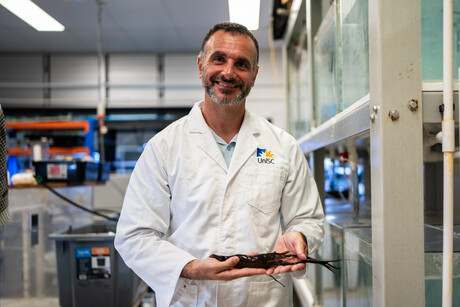
An Indigenous-led collaboration plans to develop a freshwater prawn industry in Far North Queensland, combining ancient knowledge with modern hatchery science.
Until now, the native prawn species (Macrobrachium rosenbergii) is plentiful in rivers, lakes and creeks in Australia, but it hasn’t been harnessed through aquaculture.
A custom-built hatchery established at the aquaculture facility of University of the Sunshine Coast now represents the starting point for a potentially lucrative market for the giant native prawn species.
Associate Professor Tomer Ventura leads the technical work at the University of the Sunshine Coast. He brings seven years of hands-on experience with the species from his graduate research, including co-inventing a patented technology for all-male production.
“Over the past few months, we’ve achieved what’s believed to be the first commercial-scale production of this prawn, Macrobrachium rosenbergii, in Australia,” Ventura said.
“It’s an exciting foundation for this sustainable aquaculture pilot project led by Indigenous communities in Far North Queensland in partnership with CSIRO.”
The Regional University Industry Collaboration (RUIC) project is funded by the Queensland Government and delivered by CSIRO. The project leader, Hope Vale Foundation, is working with the University of the Sunshine Coast team, which has tailored breeding methods and technology to the species to enable faster and bigger growth.
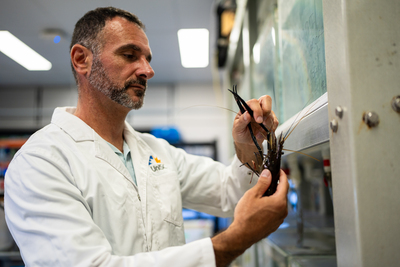
“We started with a delivery of 20 or so male and female adult prawns, transported 1900 km from near Cooktown by project leader the Hope Vale Foundation,” Ventura said.
“Our aim was to produce 10,000 post-larvae prawns but we rapidly passed that. I never imagined we would end up with 200,000, and from such a small hatchery footprint.
“That’s enough to stock an entire farm — not just a pond — which significantly exceeds the original goals of this pilot. There is infinite potential from this humble beginning.”
Ventura, who researches crustacean genetics and aquaculture, said the team was able to produce up to 200 g a day of live feed (microscopic crustaceans called Artemia) for the prawns and was now investigating alternative sustainable feed options.
“In a week or two, the prawns will be big enough to send back to the Hope Vale Foundation to grow to adult size in their ponds.”
The foundation, a First Nations not-for-profit, is spearheading the effort to blend traditional ecological knowledge with cutting-edge aquaculture science. The project aims to develop a scalable, low-emission, water-efficient model that supports food security, economic empowerment and cultural resilience.
“By blending ancient wisdom with cutting-edge agtech, we’re building a scalable hatchery-to-grow-out model that’s low-emission, water-efficient and culturally grounded,” said Tony Matchett from Hope Vale Foundation.
Six on the shelf: from frozen treats to smoothies & meal kits
Many of the new product developments hitting the shelf of late have been designed for specific...
What nutrients are in your milk?
A US study has revealed that the nutrients contained in milk may vary from the label depending on...
Six on the shelf: from reformulated Vegemite to award-winning dips
A spread reformulated for kids, together with indigenous-inspired baked goods, award-winning dips...