Food inflation: let's take a look inside the basket
On 29 October 2026, the latest Australian Bureau of Statistics (ABS) data showed annual inflation rose to 4.3% in September. While food and non-alcoholic beverage inflation was lower than the overall rate, it didn’t disappear — with prices in this category rising 3.2% year-on-year to September, up from 3.0% to August.
Beneath the headline numbers, Australia’s food inflation story is nuanced and the character of the inflation has changed with price movements and pressures varying across categories, according to Rabobank analysis.
“Rather than broad-based inflation across the supermarket basket, we’re now seeing much greater divergence between categories,” said RaboResearch senior food analyst Michael Harvey.
“Animal proteins are a good example. Beef remains an inflation hotspot, although price growth has slowed considerably from its peak earlier this year.
“Beef and veal prices were 5.8% higher year-on-year in September, down from a peak of 13.5% in February. By contrast, pork prices fell 1.3% year-on-year, marking a second consecutive month of price deflation, while poultry inflation was subdued at just 0.4%.”
Dairy inflation is shown to be running slightly above overall food inflation, Harvey said. Dairy and related product prices increased 3.5% year-on-year, led by liquid milk at 5.4%, while cheese price inflation was considerably softer at 1.8%. The ‘softer’ cheese result is consistent with more subdued conditions in global cheese markets, Harvey said.
Fresh food was another source of price pressure in the latest data, with fruit prices rising 10.2% year-on-year to September. “Fruit prices are inherently volatile and particularly sensitive to seasonal availability and changing supply conditions,” Harvey said.
Australian food inflation, year-on-year change, September 2026
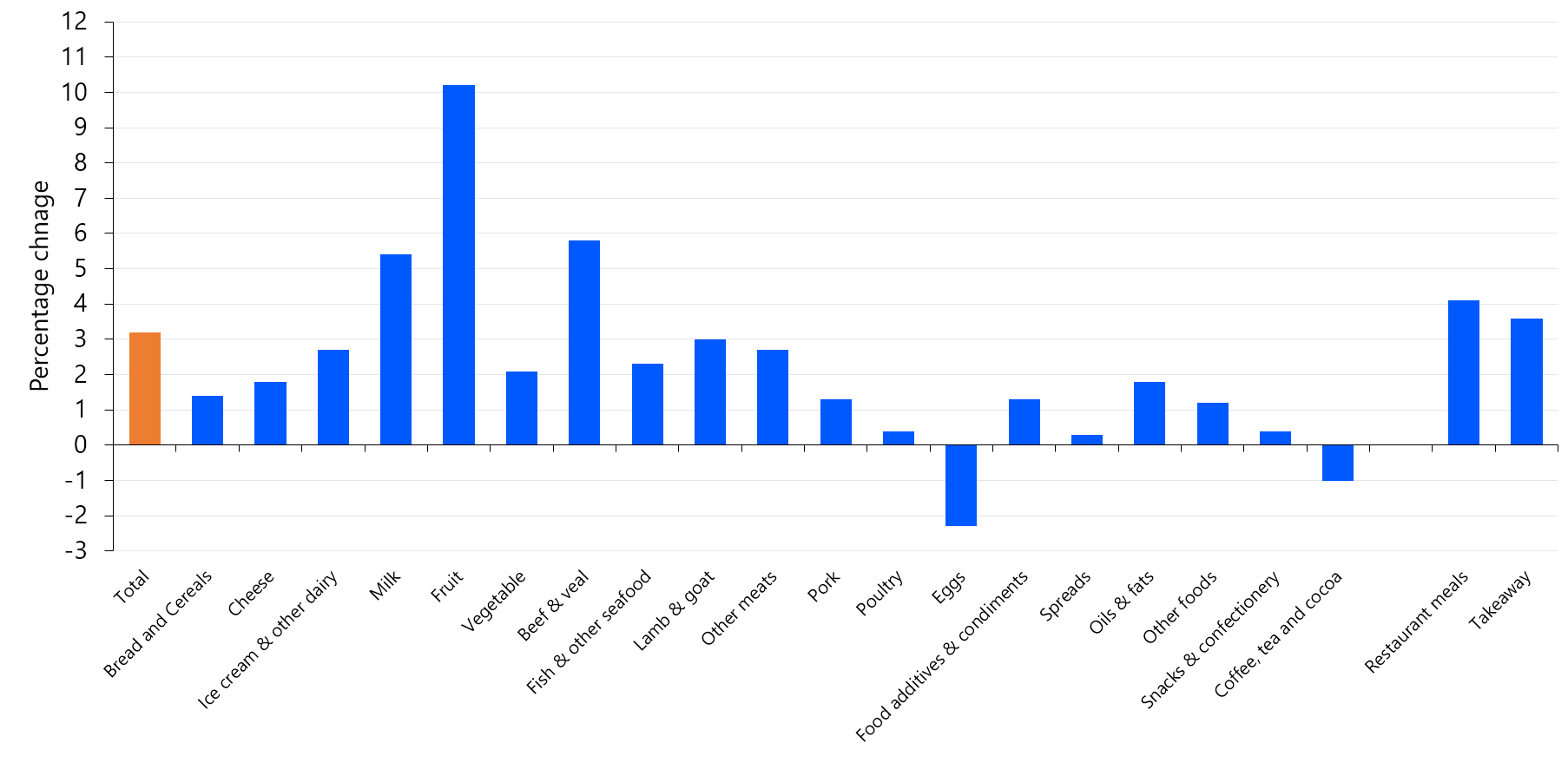
There had also been a material easing in parts of the non-alcoholic beverage category, Harvey said, with coffee, tea and cocoa prices declining 1.0% year-on-year in September, in contrast to stronger inflation elsewhere in the beverage aisle.
AFGC comments about tackling the cost of manufacturing in Australia
On release of the inflation figures, the Australian Food and Grocery Council (AFGC) said it reinforces the need to address cost pressures facing businesses involved in making everyday essentials and Australian households alike.
AFGC CEO Colm Maguire said persistent inflation was a reminder that Australia needed to tackle the costs embedded throughout the food and grocery supply chain.
“Food and grocery manufacturers continue to face significant pressure from energy, freight, packaging, ingredients and regulatory costs. When costs rise across the supply chain, those pressures cannot simply be absorbed indefinitely by one party alone.”
Maguire said Australia should use the renewed focus on inflation to look at the conditions facing businesses producing essential goods.
“Reducing the cost of doing business is part of reducing the cost of living. We need policies that make Australia an attractive place to invest, improve productivity and keep making food and grocery products.
“A strong domestic manufacturing sector matters for jobs, investment and Australia’s long-term food and grocery security.”
For more details on the latest Consumer Price Index (CPI) figures from the ABS, click here.
SPC Global proposes name change to reflect diversified business
SPC Global said it will seek shareholder approval on 24 November to change its name to Altival...
Ferrero’s Nutella factory in Lithgow turns 50
Ferrero celebrated the 50th anniversary of its Lithgow factory in NSW on 25 October, which now...
Lindt leadership changes at CEO level
Lindt & Sprüngli has announced that Dieter Weisskopf is taking on the role of interim...