A circular approach to food waste for chicken meat
A federally funded research project has demonstrated how commercial food waste can be converted into nutritious feed for meat chickens, delivering a practical circular economic outcome.
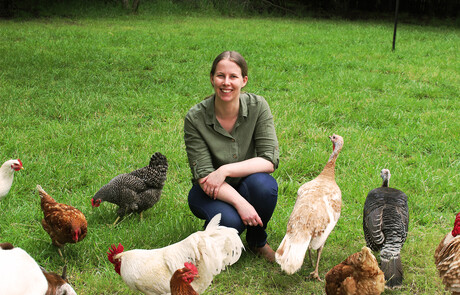
Dr Amy Moss, a poultry researcher from the University of New England (UNE), was awarded a $410,000 Discovery Early Career Researcher Award (DECRA) from the Australian Research Council (ARC) in 2023, administered through the Australian Government by the Federal Minister for Education, the Hon Jason Clare.
The three-year research program investigated sustainable feed options for meat chickens, including trials using a commercial food waste diet. The project was conducted in partnership with industry to ensure the findings were commercially relevant and scalable, and provided the best value for the poultry sector.
Moss partnered with Food Recycle Ltd, which has developed a patented process to convert commercial food waste into high-value feed suitable for poultry, pig and aquaculture applications.
According to Moss, the cost of feed for meat chickens makes up about 70% of the cost of production.
“As food waste is significantly cheaper than commercial poultry feed, it can provide significant economic and environmental benefits,” Moss said.
Building on a successful earlier trial with layer hens, where the Food Recycle food waste diet was reported to have outperformed commercial poultry feed, the latest trial used food waste from commercial sources including brewers’ grains, bakery waste, and food collected from TAFE colleges, restaurants and hospitals.
The trial ran over 42 days — the entire production span of a meat chicken — and once again, the food waste diet outperformed the control commercial feed.
A control diet using typical commercial ingredients (wheat, soybean meal and canola meal) and one consisting of 50% food waste ingredients both performed statistically similarly over starter, grower, finisher and withdrawal phases of a meat chicken’s development. The findings concluded that “due to the substantially lower cost of food waste diets, all food waste treatments significantly improved feed cost (AU$) per kg live gain”.
Following the success of the UNE trials, the same technology is now being rolled out in NSW and the ACT as part of a new Food Recycle Co-Operative, before being taken to a national scale. The Co-Operative will allow commercial food waste to be collected and converted into high-value poultry, pig and aquaculture feed.
Unlike most waste services that charge disposal fees, the co-operative model enables members to benefit from both 30–40% savings in disposal costs and the opportunity to receive dividends from the sale of animal feed produced.
“With new Food Organics and Garden Organics (FOGO) rules being introduced in NSW from July 2026, this is an opportune time for businesses to take advantage of the Food Recycle Co-Op to both reduce disposal costs and earn money from dividends,” said Food Recycle CEO Norm Boyle.
The project highlights how strategic government investment in early-career research can translate into real-world environmental and economic benefits.
FSSC Certification Scheme now includes Save Food Packaging
FSSC, WPO and AIP have united to introduce Save Food Packaging requirements into Version 7 of the...
Upcycling cauliflower waste into protein ingredients for future food
RMIT researchers have developed an ultrasound method to extract protein from discarded...
Aussie wrapping solution for pallets designed to save waste
Melbourne-based founder of the frank green re-usable water bottle has now developed a re-usable...