Unleashing the Capabilities of AI‑Assisted Quality Control
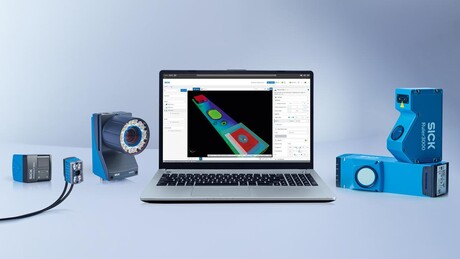
Artificial Intelligence (AI) is reshaping the future of machine vision, enabling manufacturers to achieve unprecedented accuracy, speed, and reliability in quality control. As production lines grow more complex and expectations for defect‑free output skyrocket, AI‑enabled inspection systems have emerged as the new standard — lifting the limitations of traditional rule‑based approaches and opening the door to smarter, more adaptable manufacturing environments.
In today’s competitive landscape, quality issues don’t just create scrap or rework; they harm brand reputation, compromise safety, and inflate operational costs. As a result, manufacturers across sectors — from food and beverage to packaging, pharmaceuticals, and logistics — are accelerating their adoption of AI‑powered vision technologies to safeguard consistency, unlock productivity, and future‑proof their operations.
Streamlining Machine Vision with AI Functionality
Historically, configuring machine vision applications required extensive rule‑based programming. Engineers had to manually specify thresholds, geometric patterns, tolerances, contrast settings, and complex logic trees. This approach worked reasonably well for stable, highly predictable environments — but started to fall short when products varied, materials changed, or lighting conditions fluctuated. The system was only as good as the rules that governed it.
AI‑enabled vision technology transforms this paradigm. Instead of hardcoding rules, users “teach” the system through examples. With a curated dataset of images representing good and bad conditions, the sensor learns to differentiate product patterns, detect anomalies, and adapt to subtleties that would normally challenge conventional vision tools.
This shift dramatically reduces deployment time. Instead of spending hours fine‑tuning individual parameters, operators can accelerate development cycles with intuitive training workflows. The system becomes not only smarter but also more resilient — capable of handling real‑world variability with greater precision.
As Praveen Kannan, Senior Director, Focus Sales Asia Pacific, notes:
“AI has fundamentally changed how customers approach machine vision. What previously required expert‑level programming can now be achieved in minutes with image‑based training. It democratises complex inspection tasks and ensures manufacturers stay agile, efficient, and competitive.”
Intelligent Inspection Toolset: Effortless and Advanced Solutions
The Intelligent Inspection toolset is designed to simplify both deployment and ongoing operation. Built on Deep Learning technology, these tools excel in applications where traditional deterministic logic struggles — especially in tasks such as:
- Subtle defect detection: scratches, dents, inclusions, inconsistent textures
- Object classification: distinguishing product variants that appear similar
- Feature recognition: identifying patterns that vary due to natural product variability
- Sorting and grading: evaluating items against complex quality or condition criteria
One of its most powerful advantages is its compatibility with both 2D and 3D vision sensors. This multimodal flexibility equips manufacturers with the ability to inspect fine surface details, dimensional irregularities, volume deviations, and shape inconsistencies — all within a unified platform.
This makes the Intelligent Inspection toolset ideal for high‑mix, high‑speed production environments where quality must be guaranteed without slowing throughput.
According to Praveen Kannan:
“Our customers want a solution that works reliably from day one and continues to improve over time. The Intelligent Inspection toolset gives manufacturers the confidence that no matter how complex their inspection needs are, the system will keep up with them.”
SICK Nova: A Flexible and Scalable AI Software Platform
The backbone of this ecosystem is SICK Nova, an adaptable software platform engineered for a wide range of industries and use cases. Its intuitive web interface removes barriers to adoption — allowing users with varying levels of machine vision expertise to configure, monitor, and optimise inspection tasks.
SICK Nova delivers several critical advantages:
1. Scalability and modularity
Nova supports a vast portfolio of hardware including 2D cameras, 3D cameras, and LiDAR sensors. Manufacturers can scale from simple vision tasks to highly advanced inspection pipelines without switching platforms.
2. Plug‑in architecture
Users can enhance system capabilities through both pre‑built and custom plug‑ins. This provides:
- Configurable function blocks
- Tailored workflow automation
- Application‑specific intelligence
- Reduced total cost of ownership
3. Cross‑industry compatibility
Nova’s adaptability makes it useful for sectors such as food manufacturing, automotive, consumer goods, electronics, packaging, warehousing, and logistics.
4. Ease of integration
Interfacing with PLCs, robots, and control systems becomes seamless, promoting efficient communication and improving end‑to‑end process reliability.
As Praveen Kannan explains:
“SICK Nova is a game changer for machine vision. It breaks down the complexity of high‑end inspection and gives every customer — from small plants to major manufacturers — the ability to deploy AI at scale.”
Transforming Quality Control in Australian Manufacturing
Manufacturers across Australia are increasingly embracing AI‑powered inspection due to rising labour constraints, tighter compliance requirements, and the need for higher production yields. Food and beverage producers in particular are seeing measurable benefits.
From inspecting seals on packaged goods, ensuring correct labelling, verifying fill levels, and detecting foreign objects or contamination risks, AI‑driven machine vision is delivering higher accuracy and fewer false rejects — helping plants maintain quality consistency without slowing down throughput.
Praveen says: “SICK AI‑powered machine vision is truly transforming in‑line quality control at food manufacturing sites across Australia. Customers are reporting improvements in uptime, reduction in waste, and significantly enhanced detection capabilities that were previously unattainable.”
This shift is not merely technological — it’s strategic. Manufacturers are leveraging AI tools to safeguard brand integrity, meet rising consumer expectations, and build more resilient supply chains.
Commitment to Innovation: A Culture of Continuous Improvement
At its core, SICK remains committed to pushing the boundaries of industrial automation. Innovation is not just a guiding principle — it is a responsibility to customers striving for excellence in production, digitalisation, and operational intelligence.
Through deep collaboration with customers, SICK converts real‑world challenges into practical solutions. From concept to deployment, the company integrates smart sensors, AI capabilities, and user‑centric software design to ensure that manufacturers can:
- Improve efficiency
- Reduce operational risk
- Enhance product quality
- Enable long‑term competitiveness
Praveen concludes: “The future of manufacturing belongs to those who embrace AI‑driven automation. At SICK, we are committed to guiding our customers on this journey — helping them evolve from traditional inspection to intelligent, AI driven Quality Control.”
Robust cable solutions for food and beverage manufacturing
By choosing robust cabling from the outset, food manufacturers can help to protect the...
How Smarter Compressed-Air Monitoring Can Help Food & Beverage Manufacturers Improve Reliability and Efficiency
ELGi's Air~Alert provides food and beverage manufacturers with connected monitoring...
From Manual Weighing to Intelligent Quality Control with METTLER TOLEDO's IND400
Why Today's Manufacturers Can't Afford to Weigh by Guesswork.