Next-gen pumps use film-based technology
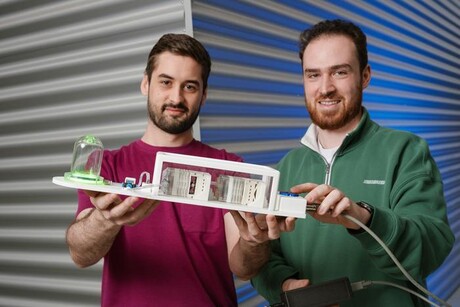
An ultrathin silicone film being developed at Saarland University in Germany enables pumps to operate without motors, without compressed air and without lubricants or external sensors. These film-based pumps can be switched on and off as needed and integrated into designs previously thought impossible. Wherever a vacuum is required — from applications in manufacturing and automotive engineering to laboratory and research work — this new technology is opening up access to lightweight, flat and energy-efficient pump architectures.
The researchers apply an electrical voltage and immediately the polymer film begins to move. At just 50 micrometres thick, this ultrathin membrane has about the same thickness as a human hair. By adjusting the electrical voltage applied, researchers in Professor Paul Motzki’s team can make the film undergo powerful pulsing motions, vibrate at a desired frequency or amplitude, rise and fall in a smooth undulating motion, or hold a fixed position. What may sound like a party trick is, in fact, the basis for a new class of miniature actuators.
Because the motion of the film can be precisely controlled, it can be used to deliver localised pushing and pulling forces, generating movements that would otherwise require motors or compressed air systems — both of which need space, energy and maintenance. The research team is integrating the films into vacuum pumps that can draw air or liquid out of a chamber. Vacuum pumps are ubiquitous and indispensable in industrial applications ranging from packaging machinery and robotic grippers to medical technology.
Creating a vacuum without compressed air and without a motor
The film technology being developed in Saarbrücken is designed to eliminate the need for heavy components and enables lightweight, compact pump designs. “Using dielectric elastomers — as these electrically responsive polymer films are known — we can tailor pump geometries to specific requirements. That means that we can create forms that would not be technically feasible using conventional approaches. For example, we can produce extremely thin, flat designs comparable to the shape of a smartphone,” said Paul Motzki, who is Professor of Smart Material Systems at Saarland University and Scientific Director/CEO at the Center for Mechatronics and Automation Technology in Saarbrücken (ZeMA).
The film-based pumps can operate in compact, sensitive environments. One of the benefits of dielectric elastomer technology is that it does not need expensive or hard-to-source materials like copper or rare earth elements. And because it operates without lubricating oil, it is suitable for applications in cleanrooms and sterile settings.
“Depending on the operating mode, our membrane pumps can also be very energy efficient,” Motzki said. The pumps also run quietly — an advantage that could help to reduce background noise levels in production halls and assembly lines.
More actuators create greater power
At this year’s Hannover Messe, Motzki’s team exhibited the new prototype that illustrates how their technology can be scaled. Their latest vacuum-pump prototype is equipped with a dual drive. Last year, the team presented a single film drive in a single pump chamber. This year, they are showcasing a dual-drive prototype that features two film actuators in two pump chambers. “We can connect the two actuators either in parallel or in series, increasing pressure, volumetric flow rate and overall power,” Motzki said.
The two film-based drives can operate in opposing phases, with one side in intake mode, while the other discharges. This prevents performance drop-off and allows the pump to deliver higher flow rates and greater pressure capability — generating a continuous vacuum quickly and without cycling. The new dual-actuator design delivers a marked performance gain. Whereas the single chamber pump was able to achieve an absolute pressure of approximately 300 mbar, the new system can get down to below 200 mbar absolute. “And we can connect additional membranes in series or parallel to tailor and further boost performance — depending on application needs,” Motzki said.
Another step towards industrial deployment
The new version of this motor-free vacuum pump is another step towards industrial deployment for Motzki’s team. The technology is also being used for a wide range of other applications, from robotic grippers and loudspeakers to smart textiles and haptic feedback systems for smartphone displays. For example, the team has developed a smart industrial glove that can respond to how the operator’s hand and fingers move and communicate this information to a computer.
The team is now looking for partners with whom they can develop applications that bring their film-based pump technology to market.
58% of food manufacturers report less productivity, research finds
Argon & Co research found that Australian food and beverage workers were still doing a lot of...
Humidification solution for Tasmanian Botanics
Australian medicinal cannabis producer Tasmanian Botanics required a solution to control humidity...
How AI is changing the way food and beverage manufacturers prevent and manage recalls
Businesses that stand to benefit the most will be those with all their data in one place,...