Post-harvest system to improve safety and extend shelf life
A synergistic system using cold plasma and smart coating has been developed to suppress microbial growth, degrade pesticide residues and extend the shelf life of cherry tomatoes — potentially providing a safer and more sustainable approach for fresh produce preservation.
Fresh fruits and vegetables are susceptible to post-harvest deterioration and contamination. Cherry tomatoes, with their thin skin and high moisture content, are particularly vulnerable to microbial spoilage and rapid quality loss during storage. Meanwhile, pesticides such as chlorpyrifos are widely applied in agriculture to control pests and diseases, often leaving residues that need to be removed for food safety reasons.
Current strategies for pesticide removal — including physical, chemical and biological approaches — frequently face limitations such as incomplete degradation, potential formation of harmful by-products, and limited scalability. Although emerging technologies like cold plasma and edible coatings show promise, each method alone has constraints in penetration depth, stability or degradation efficiency, highlighting the need for integrated solutions to improve both food safety and post-harvest preservation.
A study published in Food Materials Research by Jie Zou’s team, Jiangsu Product Quality Testing & Inspection Institute, reports that combining a DAT/SA composite coating with DBD plasma significantly enhances microbial inhibition, extends shelf life, and increases chlorpyrifos degradation efficiency in cherry tomatoes.
To develop the preservation system, researchers synthesised chiral D-cysteine/gold nanoparticle-modified titanium dioxide (DAT) nanoparticles and incorporated them into a sodium alginate (SA) matrix to form a functional composite edible film. The DAT nanoparticles were produced through citrate reduction of gold salts followed by surface functionalisation and photodeposition onto TiO2 particles. These nanoparticles were then dispersed in sodium alginate solutions at different concentrations to prepare composite films with tunable physicochemical properties. Film performance was evaluated by measuring water solubility and water vapour permeability, and the formulation containing 0.3% DAT was selected for further experiments due to its optimal mechanical strength and barrier performance.
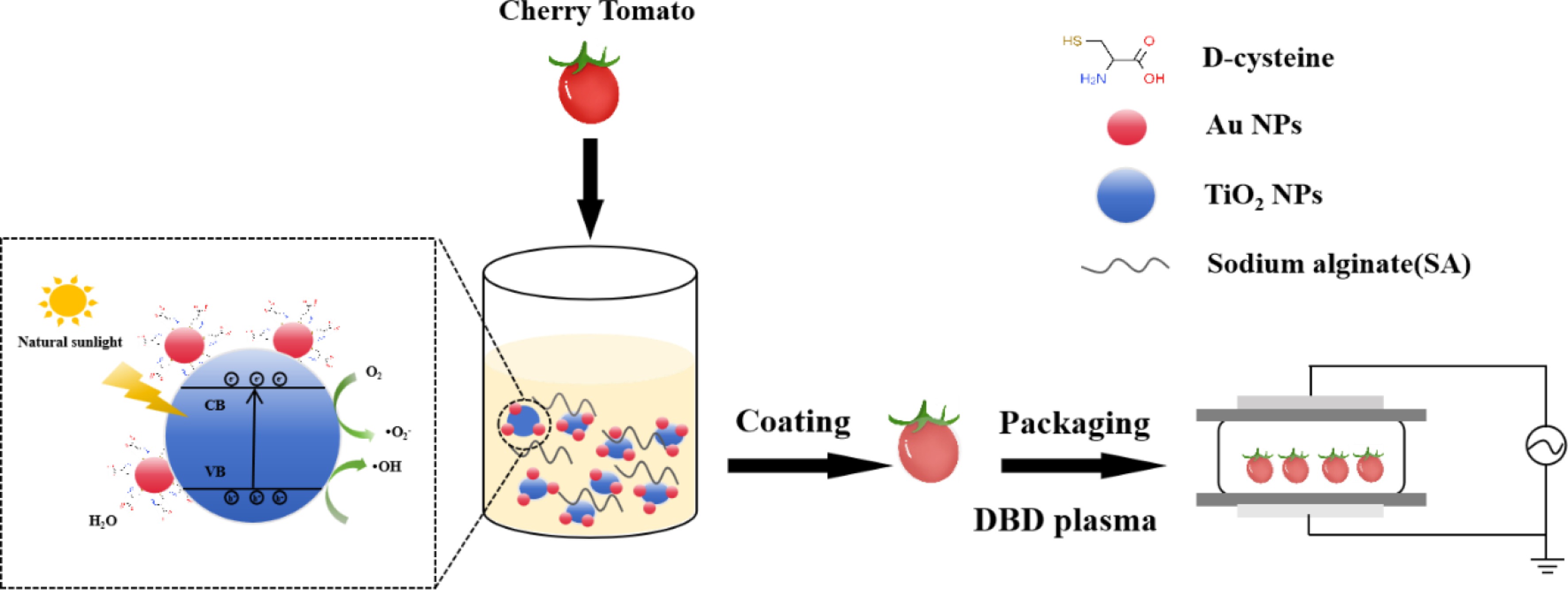
Results showed that the integrated treatment effectively suppressed microbial growth. Compared with untreated samples, the combined system reduced total bacterial counts by up to 1.28 log CFU/g, demonstrating strong antimicrobial activity. Fruit quality was also better maintained: tomatoes treated with DAT/SA coating and plasma retained higher firmness, reaching 1.36 times that of untreated fruit after 11 days, while weight loss was significantly reduced. The onset of decay was delayed, extending the storage life by more than four days compared with the control.
In addition to preservation, the system enhanced pesticide removal. Chlorpyrifos residues were analysed using UPLC–MS after QuEChERS extraction. While natural degradation removed about 31.35% of residues, the combined plasma–coating treatment achieved 65.86% degradation, exceeding individual treatments. Residue levels fell well below regulatory limits, indicating improved food safety. This enhanced degradation is attributed to the interaction between plasma-generated UV radiation and the photocatalytic DAT nanoparticles, which produce reactive oxygen species capable of breaking down pesticide molecules.
Overall, the study demonstrates that integrating plasma technology with functional edible coatings can provide a dual-function strategy for fresh produce preservation. The DAT/SA film acts as a protective barrier that reduces moisture loss and slows ripening, while DBD plasma generates reactive species that eliminate microbes and degrade pesticide residues. Together, these processes produce a synergistic effect that improves food safety and prolongs shelf life without relying on chemical preservatives.
Platform launches in Australia to help lift automation adoption
Robotics Australia Group has launched an initiative that is designed to take the guesswork out of...
Arnott's Group celebrates its suppliers at Sydney event
The Arnott's Group has celebrated the contributions of its supply partners across operations...
Top 6 impacts of robots, revealed in IFR position paper
The International Federation of Robotics' latest position paper reveals how robots can have a...